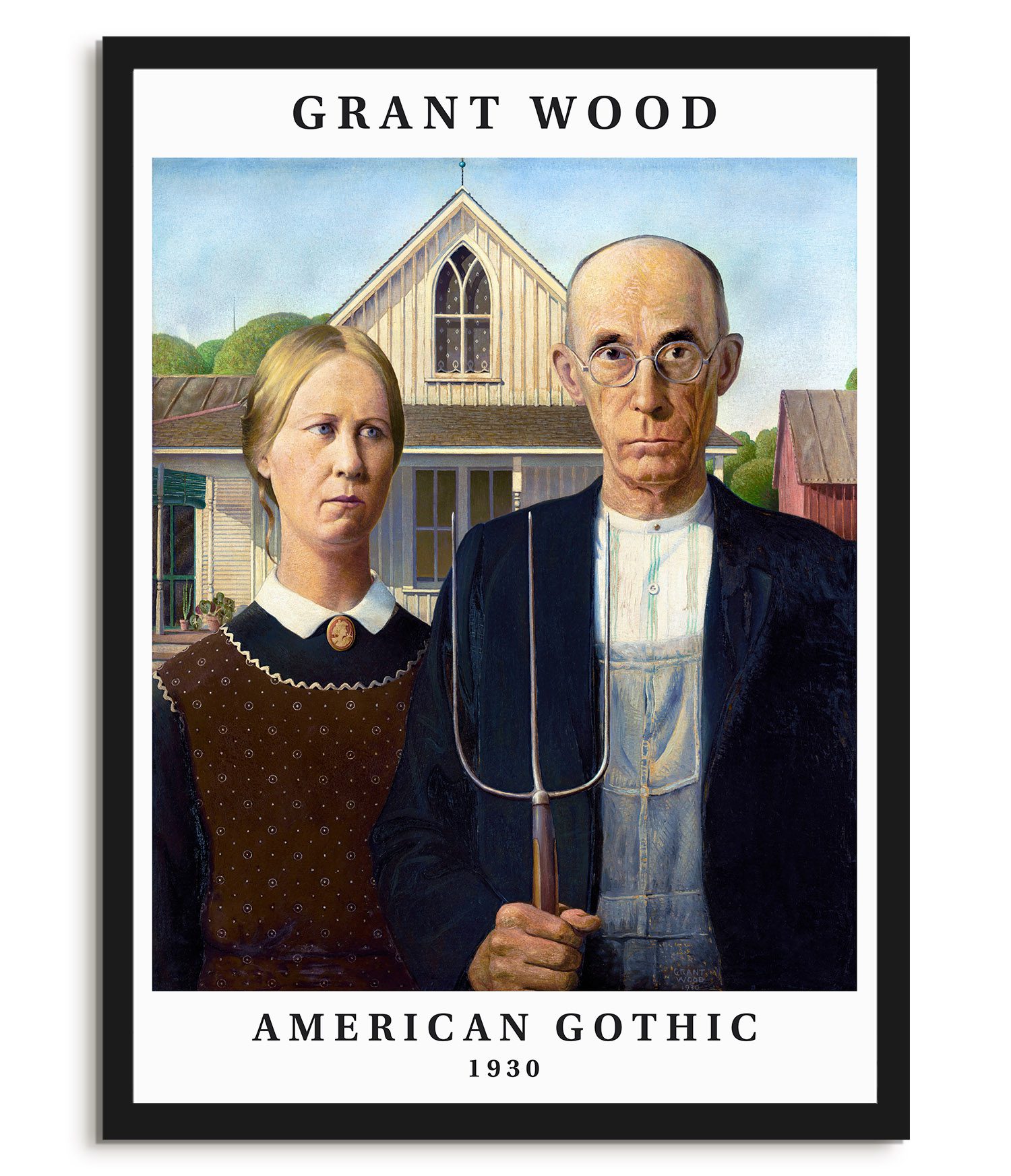
You’ve seen it a thousand times. It’s on coffee mugs, political cartoons, and cereal boxes. That stern couple—the man with the pitchfork and the woman in the colonial print apron—staring right through you from the porch of a white house. Honestly, the American Gothic painting by Grant Wood is probably the most parodied work of art in history, second only to the Mona Lisa. But here’s the thing: almost everyone misreads it.
People usually assume it’s a husband and wife. It isn't. People think Wood was making fun of "hicks" in the Midwest. He wasn't. And that house? It wasn't some grand estate or a set built for the painting. It was just a little cottage in Eldon, Iowa, that Wood saw while riding in a car. He thought it was ridiculous that such a tiny, humble house had such a fancy, "Gothic" window.
It's a weird painting. It’s stiff. It’s obsessive. It’s deeply Iowa.
The Mystery of the Models: Not Who You Think
When Wood first exhibited the painting at the Art Institute of Chicago in 1930, it caused an immediate stir. Iowans were actually pretty ticked off. They thought Wood was portraying them as grim, pinched, and miserable. One farmwife even told Wood he should have his "head bashed in" for the depiction.
But look at the models.
The man is Byron McKeeby. He was Wood's dentist. The woman is Nan Wood Graham, Grant’s sister. Wood didn't want people to think they were a married couple; in his mind, they represented a father and his grown daughter. Nan was actually quite protective of this distinction. She was younger than she looked in the painting—Wood elongated her face and made her look much more severe than she was in real life.
She wore a cameo and a precise, 19th-century hairstyle to evoke a sense of "pioneer" stoicism. Wood was obsessed with the details. He had Nan and Byron pose separately. They never actually stood together in front of that house in Eldon. It was a composite. A construction.
That Pitchfork and the Geometry of Scarcity
The American Gothic painting by Grant Wood is a masterclass in repetition. If you look closely, you’ll see the three prongs of the pitchfork mirrored everywhere. Look at the stitching on the man’s overalls. Look at the window panes in the background. Even the shape of the man’s face follows that same elongated, vertical movement.
It’s incredibly precise.
Wood was part of the Regionalism movement. This was a group of artists—including Thomas Hart Benton and John Steuart Curry—who rejected the abstract "nonsense" coming out of Europe at the time. They wanted to paint the "real" America. For Wood, that meant the hard-working, repressed, and orderly world of the rural Midwest.
He had just returned from Munich. While there, he fell in love with Northern Renaissance art—guys like Jan van Eyck and Albrecht Dürer. You can see that influence in the "hard-edge" style. There’s no soft lighting here. No impressionistic blur. Everything is sharp enough to cut you.
The pitchfork isn't just a farm tool. It's a barrier. It’s a weapon of defense. The man is holding it like a soldier holding a spear, guarding his home, his daughter, and his way of life during the onset of the Great Depression.
The House with the Window
The "Gothic" in the title refers entirely to that window. The house is built in a style called Carpenter Gothic. Essentially, it’s a regular wooden house with "fancy" architectural flourishes tacked on to make it look more sophisticated than it actually is.
Wood found this hilarious and touching.
He saw it as a form of "pretension" among people who had very little. They wanted a touch of European Cathedral elegance in the middle of a cornfield. The house still stands today in Eldon, Iowa. It’s a museum now. If you visit, you’ll realize how small it actually is. The painting makes it feel monumental, but it’s really just a cottage.
Why Did It Become So Famous?
Timing is everything in art.
In 1930, America was sliding into the depths of the Depression. People were looking for something to hold onto. To some, the American Gothic painting by Grant Wood was a tribute to the "backbone" of America—the sturdy, resilient folks who wouldn't be broken by economic collapse. To others, especially the urbanites in New York and Chicago, it was a satire of the "narrow-minded" Bible Belt.
Wood played both sides.
He was notoriously vague about his intentions. He once said, "There is satire in it, but only as there is satire in any realistic statement." That’s a classic artist non-answer. It allowed the painting to become a mirror. You see what you want to see.
- If you love the Midwest: You see integrity and grit.
- If you hate the Midwest: You see repression and judgmental stares.
- If you’re an artist: You see incredible technical skill and composition.
The Legacy of the Pitchfork
The painting has been parodied by everyone from The Muppets to The Simpsons. It has been used to sell insurance and to protest wars. Why? Because the composition is so stable. It’s an icon.
But beyond the memes, there is a lingering sadness in the work. Nan Wood Graham’s eyes are looking slightly off to the side, while the dentist looks straight ahead. There is a tension there. It’s a portrait of a world that was already disappearing when Wood painted it. The "pioneer" era was long gone by 1930, replaced by industrial farming and urbanization. Wood was painting a memory, not a contemporary reality.
How to Appreciate American Gothic Today
To truly understand this work, you have to stop looking at it as a joke.
- Examine the textures. Look at the way Wood painted the trees in the background. They look like green puffballs, almost like lace.
- Check the reflection. Look at the window. You can see the reflection of another house across the street. Wood was obsessed with these tiny, realistic touches.
- Consider the color palette. It’s surprisingly muted. The blues and browns dominate, making the white of the house pop.
If you ever find yourself in Chicago, go to the Art Institute. Stand in front of it. It’s smaller than you think, but the presence of those two figures is overwhelming. It’s a quiet painting that screams.
Actionable Insights for Art Lovers:
- Visit the Site: The American Gothic House in Eldon, Iowa, is open to the public. You can even borrow costumes and take your own parody photo in front of the famous window.
- Study the Regionalists: If you like Wood’s style, look up Thomas Hart Benton’s murals. They have a similar energy but with more movement and "swirl."
- Look for the Details: Next time you see a high-res version of the painting, zoom in on the woman's collar. The pattern is incredibly intricate and shows Wood’s dedication to the "New Objectivity" style he picked up in Germany.
The American Gothic painting by Grant Wood remains a Rorschach test for the American identity. Whether you see it as a tribute or a critique, it remains the definitive image of the rural heartland, frozen in a moment of stoic defiance.