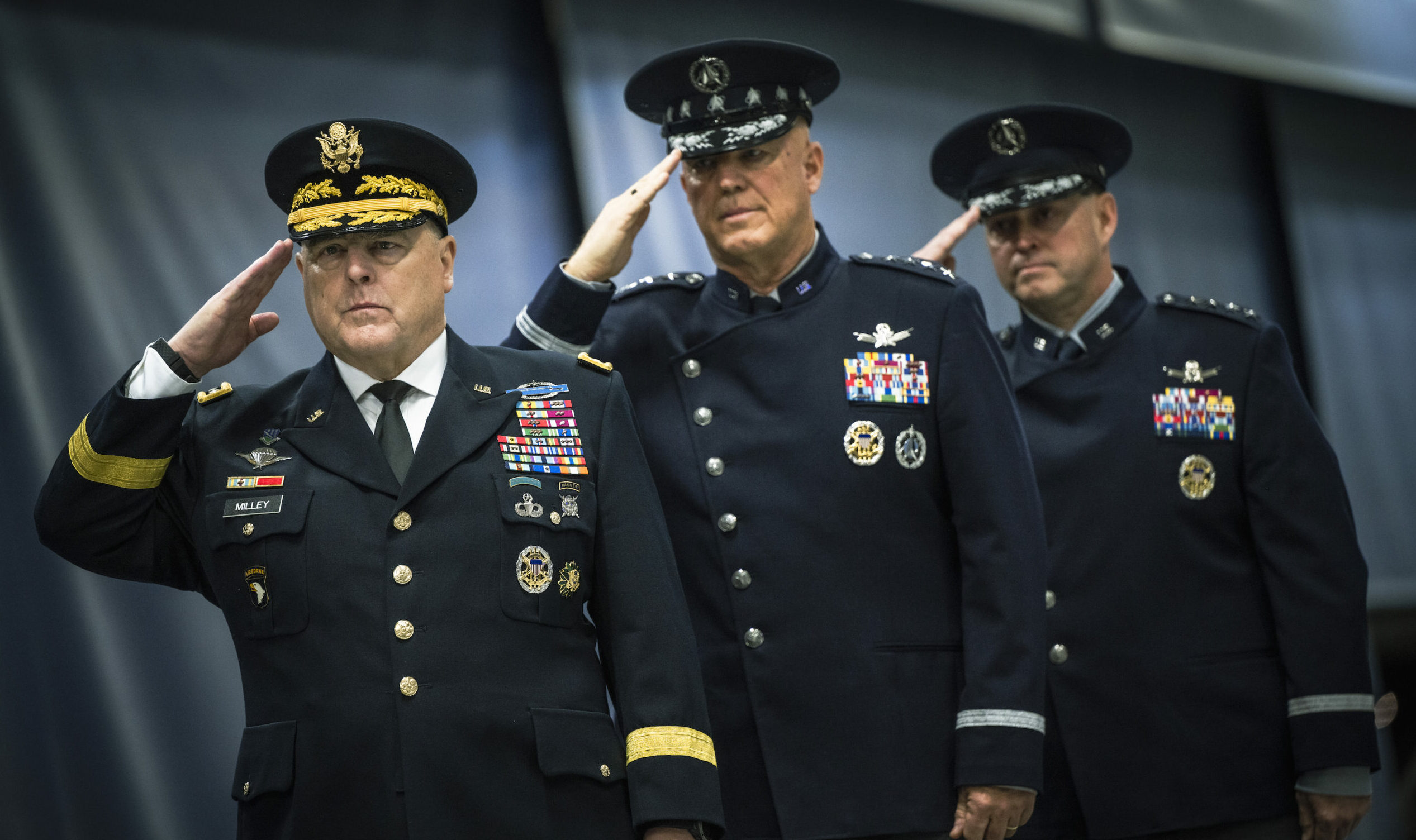
You probably haven't heard the name General B. Chance Saltzman in your daily news cycle as often as a tech billionaire or a political firebrand. But if you’ve used a GPS to find a coffee shop today, or if you care about the fact that satellites aren't currently being blown out of the sky by high-energy lasers, you've benefited from his work.
He's the Chief of Space Operations. Basically, he's the person in charge of the United States Space Force.
It is a weird job. Honestly, most people still think the Space Force is a joke from a Netflix show or something involving chrome suits and moon bases. It isn't. It’s actually about the very un-glamorous, high-stakes reality of protecting the "invisible frontline." Saltzman, or "Salty" as he’s known in the corridors of the Pentagon, is the one tasked with making sure that if a war ever kicks off, we don't lose the ability to see, communicate, and navigate from above.
Why General B. Chance Saltzman Actually Matters Right Now
We are living in 2026. Space is no longer the peaceful vacuum it was in the 90s. It’s crowded. It’s contested. It’s kinda scary.
When Saltzman took over from General Jay Raymond in late 2022, he inherited a service that was still trying to find its feet. He didn't just want to "organize" the Space Force; he wanted to turn it into a lethal, operational branch. You’ve got to realize that for decades, space was just a "support" function. It was there to help the Army and Navy do their thing. Saltzman changed the script. He started talking about Competitive Endurance.
What does that even mean?
It’s his theory of success. It’s not about winning a "Space War" in the way we think of Star Wars. It’s about making sure a war never starts because the cost of attacking our satellites is too high. He wants to "deny first-mover advantage." If an adversary thinks they can take out our GPS and blind us in one move, Saltzman’s job is to make sure they're wrong.
The History Major Who Ended Up in Orbit
It's funny, Saltzman wasn't always a "space guy." He grew up in Bowling Green, Kentucky. He actually went to Boston University on an Air Force ROTC scholarship because he needed a way to pay for school.
He started as a physics major. He hated it. Well, maybe he didn't hate it, but he was failing those upper-level classes. He pivoted to history.
That history background is probably why he thinks so differently from the engineers who usually run these programs. He looks at patterns. He looks at how navies controlled the seas in the 1800s and applies those lessons to the "orbital ocean" of today. After graduating in 1991, he spent time as a Minuteman III missile launch officer. You’ve seen the movies—the guys in the underground bunkers waiting for a key turn that hopefully never comes. That was his reality.
The Three Pillars: What Most People Get Wrong
People think the Space Force is just about launching rockets. It's way more boring and way more critical than that. Saltzman has pushed three main lines of effort since he took the top spot:
- Fielding Combat-Ready Forces: This isn't about training astronauts. It’s about training "Guardians" to handle electronic warfare. If someone tries to jam a signal, our people need to know how to fight back in the electromagnetic spectrum.
- Amplifying the Guardian Spirit: He’s trying to build a culture from scratch. That’s hard. You’re taking people from the Air Force and telling them they’re something new. He’s focused on high-level education, like the new Officer Training Course at Peterson Space Force Base.
- Partnering to Win: He knows the government is too slow. He’s obsessed with "Commercial Space Strategy." If SpaceX or a small startup in Colorado can build a better sensor faster than the Pentagon can, Saltzman wants it.
He recently pushed for the creation of Space Futures Command. Think of it as a giant "What If?" machine. Their whole job is to look at 2035 and 2040 and figure out what kind of tech we’ll need then, so we aren't caught off guard.
Is Space Superiority Even Possible?
Critics often argue that space is too big to "control." They’re right, in a sense. You can’t put a fence around a satellite. But Saltzman argues for Space Superiority.
It’s about having freedom of action. If we need to move a satellite to see what’s happening in a conflict zone, we should be able to do it without it being "dazzled" by a laser or rammed by a "stalker" satellite. He’s been very vocal about the fact that China and Russia have been testing weapons that can destroy satellites. He doesn't sugarcoat it. He basically says that if we don't get this right, the "American way of war"—and the American way of life—is at risk.
Actionable Insights: What This Means for You
You might think a four-star general's strategy doesn't affect your life. You'd be wrong. Here is how the Saltzman era of the Space Force actually impacts the world you live in:
- Protecting Global Commerce: Almost every financial transaction you make is timestamped by a GPS satellite. If Saltzman fails to protect those, the global economy hits a brick wall.
- The Rise of "Small and Many": Under his leadership, the U.S. is moving away from giant, billion-dollar satellites that are easy targets. We're moving toward "swarms" of hundreds of small satellites. If one gets hit, the network stays up.
- Career Opportunities: The Space Force is tiny—only about 15,000 people. But they are hiring. They want coders, analysts, and thinkers, not just pilots.
If you want to understand where the next decade of geopolitical tension is going, don't just look at borders on a map. Look up. General B. Chance Saltzman is currently rewriting the rules for what happens 22,000 miles above our heads. He’s turning a "paper service" into a real one, and he's doing it with the urgency of someone who knows exactly how much we have to lose.
Next Steps for Deepening Your Knowledge:
- Research the "Commercial Space Strategy" released in 2024 to see how the military is now buying tech from private companies.
- Look into "Space Domain Awareness" (SDA) to understand the tech being used to track the half-million pieces of debris Saltzman's team monitors daily.
- Follow the updates on Space Futures Command to see how the U.S. is planning for orbital logistics and refueling—the next big frontier in space longevity.