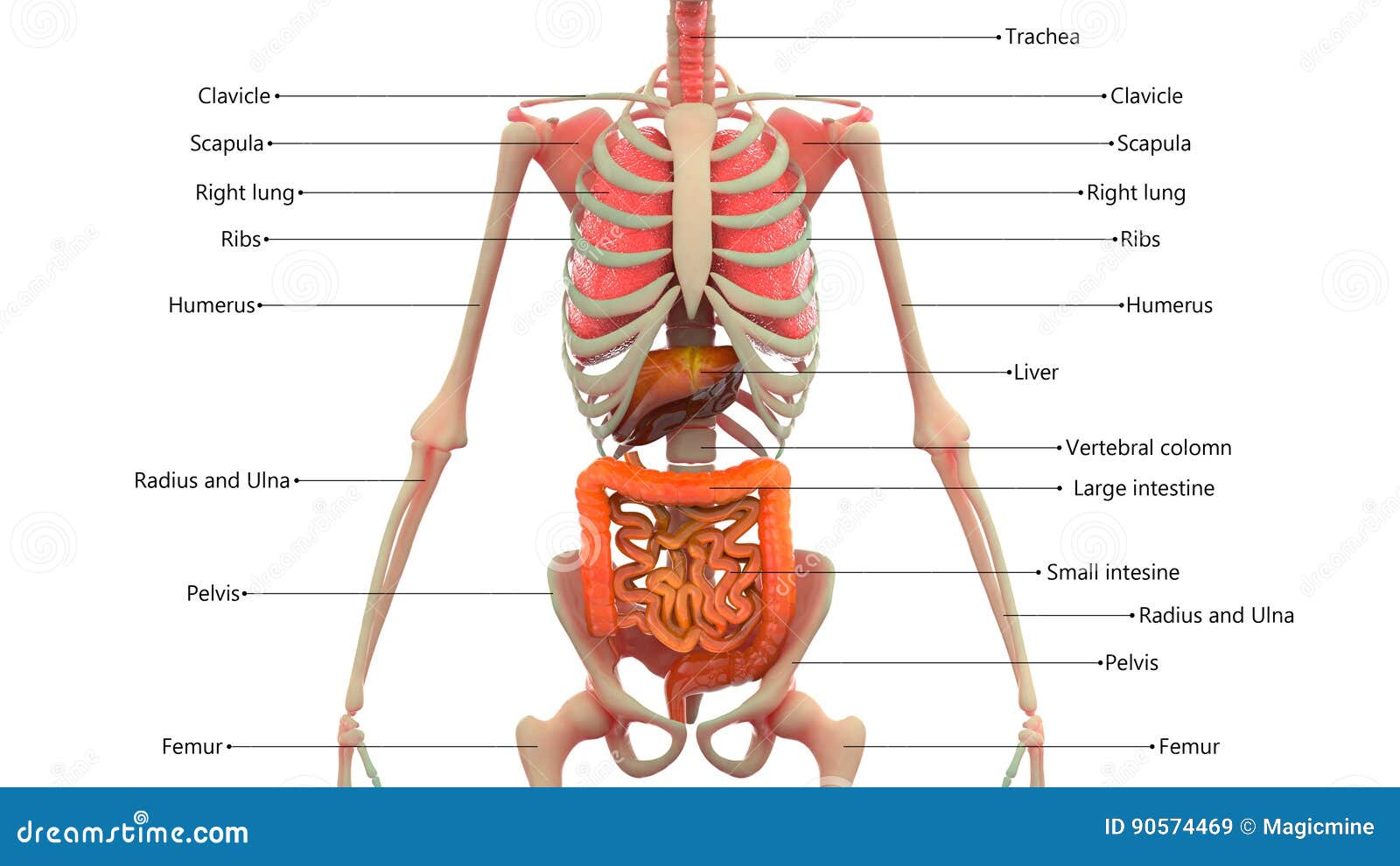
You probably imagine your insides like a high-school biology poster. There’s the cage-like rib structure, and then inside, tucked away like groceries in a bag, are the squishy bits. But honestly? That’s a bit of a lie. The human body skeleton with organs isn't just a container and its contents. It’s a messy, tight, high-pressure ecosystem where every millimeter of space is fought for.
Think about your liver. It’s heavy. It’s basically a three-pound dark red wedge of solid tissue. Without the lower right portion of your rib cage to shelf it, that thing would just sag. Your bones aren’t just "protection." They are structural anchors that keep your organs from collapsing under their own weight.
The Tight Squeeze: How the Human Body Skeleton with Organs Actually Fits
Your torso is incredibly crowded. If you’ve ever seen a surgeon perform an abdominal procedure, you know there isn't actually "air" in there. Everything is packed in with a vacuum-sealed level of precision. The relationship between the human body skeleton with organs is defined by what doctors call "anatomical relationships."
Take the kidneys. Most people think they're in the belly. Nope. They’re "retroperitoneal," which is a fancy way of saying they’re tucked way in the back, hugging the spine. In fact, your T12 to L3 vertebrae are their roommates. The bottom ribs actually shield the top of the kidneys, but only partially. It’s a risky design. One hard hit to the back can rattle the bone right into the organ tissue.
Then you have the diaphragm. This isn't a bone, but it’s the bridge. It’s a sheet of muscle that hooks directly onto your lumbar vertebrae and your lower ribs. Every time you breathe, your skeleton moves, your diaphragm pulls, and your liver and stomach literally shift up and down. You’re never static.
The Rib Cage is a Moving Shield
We call it a "cage," but that’s a terrible name. Cages are rigid. Your ribs are more like a bellows. When we talk about the human body skeleton with organs in the chest, we’re talking about the ultimate survival mechanism for the heart and lungs.
The sternum—that flat bone in the middle of your chest—acts like a shield for the heart. But the heart isn't just sitting behind it. It’s slightly to the left, nestled into a notch in the left lung. When your ribs expand, they create negative pressure. This physical movement of the bone is what allows the lungs to inflate. If the bones don't move, the organs don't work. It’s that simple.
There’s also the "floating ribs." These are the 11th and 12th ribs that don’t attach to the front. Why? Evolution is smart. These ribs give your kidneys a bit of protection while allowing your torso to bend and twist. Without that gap in the skeleton, you’d be as stiff as a board, and your internal organs would likely get pinched every time you tried to tie your shoes.
Pelvic Floor: The Skeleton’s Basement
The pelvis is the heavy-hitter of the skeletal system. In the context of the human body skeleton with organs, the pelvis is basically a bowl. It holds the weight of your entire digestive tract.
Imagine your intestines. They’re long. Like, 20-feet long. They don’t just float in your stomach; they rest on the "pelvic floor." The bony ring of the pelvis—the ilium, ischium, and pubis—provides the rigid perimeter. If you didn't have this bony basin, your bladder and uterus (in females) would have zero structural support.
Interestingly, the female pelvis is wider and shallower. This isn't just for childbirth. It changes the "carrying angle" of the legs and shifts how the abdominal organs sit. This is why certain types of hernias or organ prolapses are more common in one sex versus the other. The bone shape dictates the organ's fate.
The Brain and the Skull: A Zero-Tolerance Policy
When we look at the human body skeleton with organs, the skull is the most "exclusive" part of the skeleton. Everywhere else in the body, organs have a little room to swell. If you twist your ankle, it gets fat. If you have an infection in your gut, it gets inflamed.
The brain doesn't have that luxury.
The cranium is a fixed volume. It’s a vault. If the brain swells even a little bit due to injury, the skull becomes its worst enemy. Because the bone won't move, the pressure goes inward, crushing the very organ it's supposed to protect. It’s one of the few places where the relationship between bone and organ is genuinely dangerous if things go wrong.
Surprising Facts About Your "Inner Mechanics"
- The Spleen’s Hiding Spot: Your spleen is tucked behind ribs 9, 10, and 11 on the left. It’s so well-protected that doctors can’t even feel it unless it’s doubled in size.
- Bone Marrow is an Organ: Honestly, we shouldn't even separate them. Your bones are organs. They produce blood. The "skeleton with organs" is a bit redundant because the skeleton is a living, secreting, blood-producing organ system itself.
- The Hyoid Bone: It’s the only bone in the body not connected to another bone. It just floats in your neck, held by muscles, acting as the anchor for your tongue.
What People Get Wrong About Bone and Organ Health
A lot of people think that if they have "good posture," their organs are fine. It’s more complex. While the human body skeleton with organs benefits from alignment, the real issue is "compression."
Sedentary lifestyles—sitting at a desk for nine hours—literally compresses the space between your ribs and your pelvis. This squashes the transverse colon and can actually slow down digestion. It’s not just a "bone" problem; it’s a "mechanical space" problem.
Also, the idea that bones are "dead" or "dry" is a total myth. Inside your body, your bones are wet, flexible, and full of blood. They are constantly "talking" to your organs via hormones. For example, your bones release a hormone called osteocalcin, which tells your pancreas to produce insulin. Your skeleton is literally part of your endocrine system.
Actionable Steps for Better Internal Alignment
If you want to keep the relationship between your human body skeleton with organs healthy, you have to think about space.
- Decompress the spine daily. Use a pull-up bar just to hang for 30 seconds. This opens up the vertical space in your torso, giving your stomach and liver a bit of "breathing room" from the pressure of the ribs.
- Diaphragmatic breathing. Stop breathing into your shoulders. Breathe into your belly. This forces the lower ribs to flare out, which massages the internal organs and keeps the connective tissue (fascia) from getting "stuck" to the bone.
- Weight-bearing exercise. This isn't just for osteoporosis. Stressing the bones makes them release those hormones that help your organs regulate metabolism.
- Hydration for the Fascia. The "glue" that holds your organs to your skeleton is called fascia. If you’re dehydrated, this glue gets brittle. You want it to be slippery so your organs can slide against your ribs without friction.
The reality is that you aren't a skeleton carrying organs. You are a singular, fluid machine where the hard parts and the soft parts are constantly exchanging minerals, signals, and pressure. Keeping your bones strong is the best thing you can do for your guts, and keeping your organs healthy is the only way to ensure your bones get the nutrients they need to stay alive.