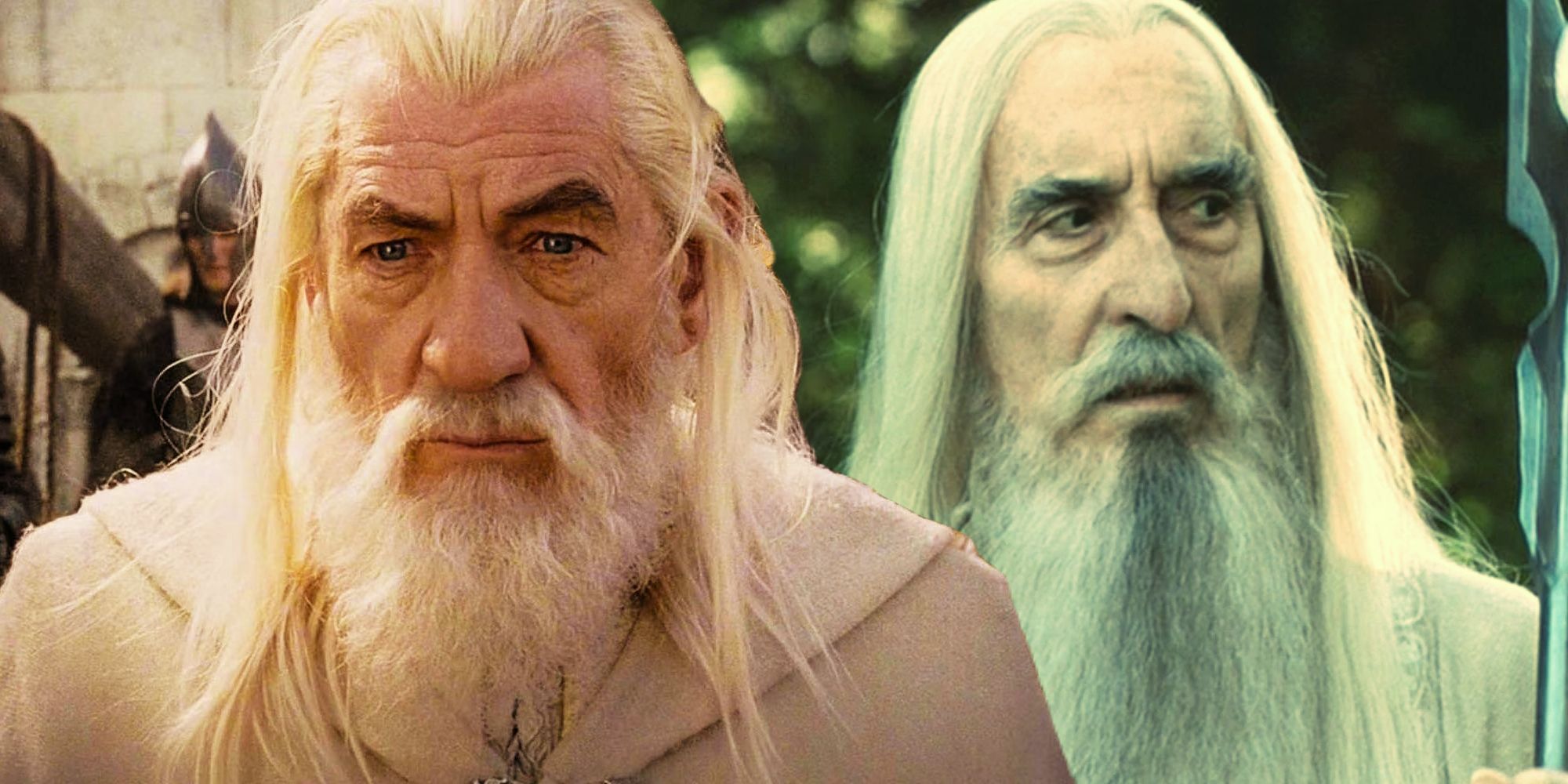
He was supposed to be the best of them. Honestly, if you look at the hierarchy of the Istari—the wizards sent to Middle-earth—Saruman was the undisputed leader. He wasn't just a guy in a robe; he was a Maia, a semi-divine spirit older than the world itself. But something went sideways. When people think about Saruman Lord of the Rings fans usually picture Christopher Lee’s commanding voice or that brutal wizard duel in Orthanc.
The tragedy is deeper than a simple "bad guy" turn.
Most people assume he just got scared of Sauron. They think he looked into the Palantír, saw a massive flaming eye, and decided to switch teams to save his own skin. That’s part of it, sure. But it’s not the whole story. Saruman’s fall was a slow-motion car crash that started centuries before Frodo ever stepped out of the Shire. It was a mix of academic ego, industrial obsession, and a crushing sense of jealousy toward Gandalf.
The Wizard Who Knew Too Much
Saruman didn't start out evil. In fact, he was the one who pushed the White Council to attack Dol Guldur. He spent centuries studying the lore of the One Ring. He became the world's leading expert on Ring-lore. He knew the smith-craft of the Elves and the dark mechanics of the Enemy better than anyone alive.
That was the problem.
Study the abyss long enough, and you start thinking you can decorate it. Saruman began to believe that the only way to defeat a Dark Lord was to have a smarter, more efficient Dark Lord in charge. He didn't want to serve Sauron; he wanted to replace him. He saw the world of Men and Elves as disorganized and fading. To him, "Order" was the ultimate good, and he was the only one with the brainpower to implement it.
Pride and the Grey Wizard
There is this awkward tension in Tolkien's writing regarding how Saruman viewed Gandalf. Early on, Círdan the Shipwright gave the Red Ring, Narya, to Gandalf instead of Saruman. Saruman found out. He never forgot it. He spent years trailing Gandalf’s movements, even going so far as to start smoking pipe-weed because Gandalf liked it, all while publicly mocking the habit.
It’s petty. It’s deeply human.
The Industrialization of Isengard and the Machine Mind
If you want to understand the Saruman Lord of the Rings narrative, you have to look at the trees. Or the lack of them. Tolkien used Saruman to represent the "machine mind." While Sauron was a distant, ancient malice, Saruman was something more modern. He was the technocrat who decided that the ancient woods of Fangorn were just fuel for his furnaces.
He created the Uruk-hai. These weren't just bigger orcs; they were a biological advancement. By crossbreeding Men and Orcs, he engineered a soldier that could walk in the sunlight without weakening. This wasn't magic in the way we usually think of it. It was chemistry. It was eugenics. It was the cold, hard logic of a man who had replaced his heart with a gear.
He basically turned the beautiful valley of Isengard into a proto-industrial wasteland. Pits. Forges. Smoke. No greenery. Just efficiency. It’s a terrifyingly relevant metaphor for what happens when "progress" is pursued without any moral guardrails.
The Palantír Trap
We have to talk about the Seeing Stone. Saruman was arrogant enough to think he could use the Palantír of Orthanc to spy on Sauron without being detected. He thought his will was strong enough. It wasn't.
Sauron didn't mind-control him like a puppet. It was more subtle. He showed Saruman exactly what he wanted him to see: the inevitable victory of Mordor. He played on Saruman's despair. Once Saruman believed the West couldn't win, the "logical" choice was to join the winner and try to steer things from the inside.
What Most People Get Wrong About the End
The movies do Saruman a bit dirty by ending his story at the top of his tower. In the books, his ending is much more pathetic and, frankly, more interesting. After losing everything—his army, his power, his dignity—he doesn't just disappear. He goes to the Shire.
Under the name "Sharkey," he sets up a small-scale dictatorship in the land of the Hobbits. Why? Pure spite. He couldn't rule Middle-earth, so he decided to ruin the one place Gandalf loved. He brought industry to the Shire, cutting down the Party Tree and building ugly mills.
It shows who he really was at the end: a small, bitter man who couldn't stand to see others happy. When Gríma Wormtongue finally slits his throat on the doorstep of Bag End, Saruman’s spirit rises like a grey mist. He looks toward the West—toward the home of the gods—but a cold wind blows from the North and sweeps him away into nothingness. He was denied the return. He was a Maia who had utterly disqualified himself from grace.
How to Apply the Lessons of the White Wizard
Understanding Saruman Lord of the Rings lore isn't just about trivia; it’s about recognizing the "Saruman" tendencies in our own world. He represents the danger of the "ends justify the means" mentality.
- Audit your motivations: Are you pursuing a goal because it's right, or because you want to prove you're the smartest person in the room? Saruman's expertise became his blindfold.
- Beware of echo chambers: The Palantír was the ultimate echo chamber. It showed him a curated reality that broke his spirit. Always seek out information that challenges your "inevitable" conclusions.
- Respect the "unproductive": Saruman saw the Ents and Hobbits as irrelevant. They were the ones who ended him. Never dismiss things just because they don't fit into your spreadsheet of efficiency.
If you're looking to dive deeper into the technical side of his fall, read The Unfinished Tales. It contains "The Istari," an essay that breaks down exactly how the wizards were chosen and why Saruman was always the most vulnerable to the lure of power. It’s a sobering look at how the greatest among us are often the ones with the farthest to fall.
To see the visual evolution of this corruption, re-watch the Extended Edition of The Two Towers. Pay attention to the color grading in the Isengard scenes. The shift from the natural whites and greys to the muddy, metallic browns tells the story of his soul better than any dialogue could. Keep an eye on the staff, too—it's a symbol of the authority he eventually forfeited for a scrap of temporary power.