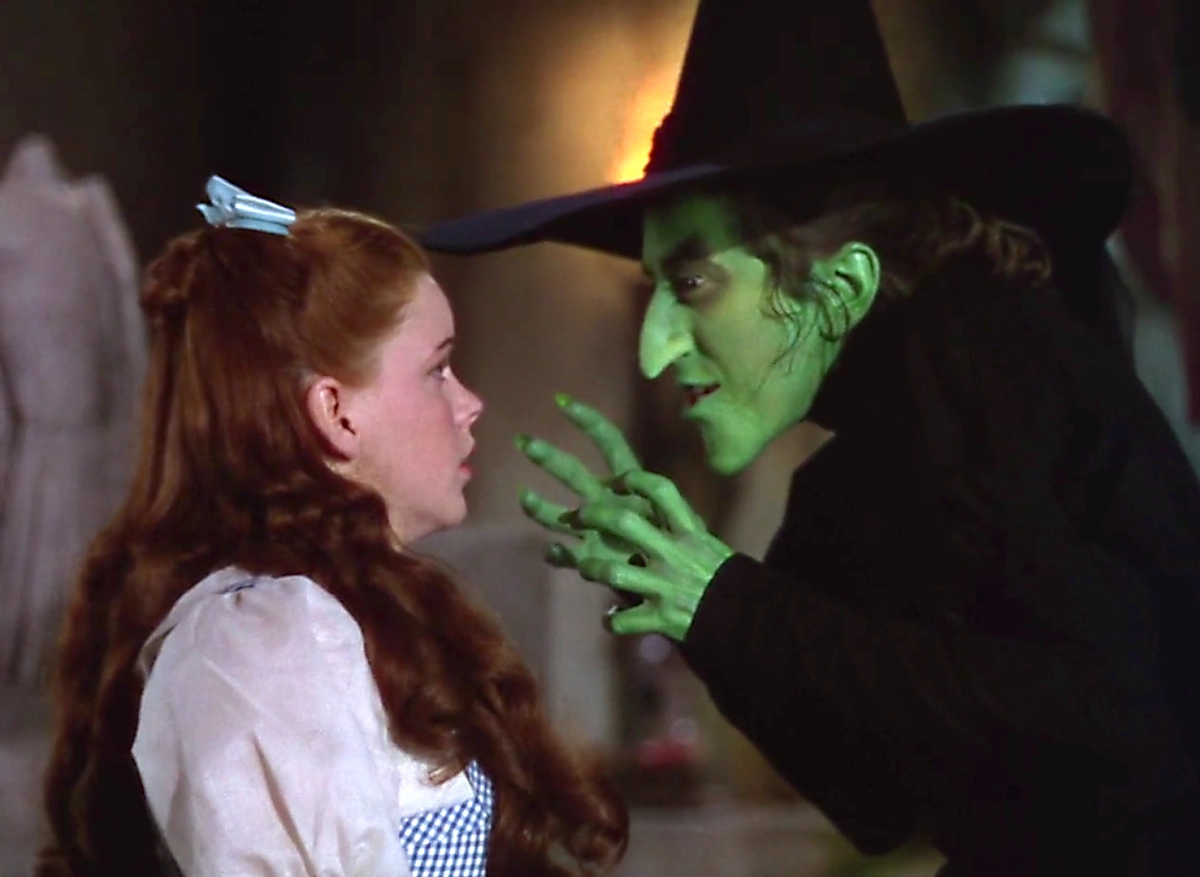
She isn't just a villain. Honestly, the bad witch on Wizard of Oz—specifically Margaret Hamilton’s portrayal in the 1939 MGM classic—is the blueprint for every cinematic nightmare we've had since childhood. You know the laugh. That high-pitched, skin-crawling cackle that feels like nails on a chalkboard. But if you look past the green skin and the flying monkeys, there is a weirdly complex history behind this character that most people totally miss.
L. Frank Baum wrote the original book, The Wonderful Wizard of Oz, in 1900. In his version, she was actually one-eyed. She used a silver whistle to call her minions. She didn't even have green skin! That was a creative choice by MGM to show off their fancy new Technicolor technology. Imagine that. One of the most iconic visual traits in film history was basically just a marketing flex for a camera company.
What People Get Wrong About the Wicked Witch
Most folks assume she's just "evil" because the script says so. But if you actually track her motivations in the movie, she’s basically a grieving sister who just had a house dropped on her sibling. Then, a teenager from Kansas steals her dead sister's shoes. In any other genre, that’s a revenge thriller.
The bad witch on Wizard of Oz represents a very specific kind of 1930s fear. She's the "Other." She’s the powerful, independent woman who doesn't fit into the polite, sparkling society of Munchkinland or the Emerald City. Margaret Hamilton played her with such visceral intensity that it actually caused problems. Legend has it that she was so scary that a lot of her scenes were cut or trimmed because the studio feared children would be too traumatized.
Even weirder? Hamilton was a former kindergarten teacher. She actually loved kids. She once went on Mister Rogers' Neighborhood in the 1970s just to explain to children that she was only playing a part, and she even put on the costume to show them it was just "make-believe." It’s kinda heartwarming when you think about it.
The Real Danger on Set
Hollywood was a literal death trap back then. During the scene where the witch disappears in a cloud of smoke and fire in Munchkinland, the trapdoor failed. The pyrotechnics went off while Hamilton was still standing there. She suffered second-degree burns on her face and third-degree burns on her hand. Her green makeup was copper-based, which is basically toxic. They had to scrub her raw skin with alcohol to get the paint off so it wouldn't infect the burns.
She was out for weeks. When she came back, she refused to work with anything involving fire. Can you blame her? Her stunt double, Betty Danko, also got hurt during the "Surrender Dorothy" skywriting scene. The smoking pipe exploded. These women literally bled for this movie.
Breaking Down the Witch's Power
Why does she still work as a character? It's the psychological pacing. The bad witch on Wizard of Oz doesn't actually have a lot of screen time. It’s less than 15 minutes total. But her presence is everywhere.
- The crystal ball creates a sense of constant surveillance.
- The Flying Monkeys (officially called the Winged Monkeys) provide a physical threat that Dorothy can't outrun.
- The hourglass. The ticking clock is the oldest trick in the book for building tension, and she uses it perfectly.
She’s a master of psychological warfare. She doesn't just want the slippers; she wants Dorothy to feel the hopelessness of her situation. It’s why she tells her "I'll get you, my pretty, and your little dog too!" It’s personal. It’s mean. It's legendary.
The Evolution of the "Bad Witch" Archetype
Before 1939, witches in movies were often just old hags or generic fairy tale tropes. Hamilton changed that. She gave the bad witch on Wizard of Oz a sharp, intellectual malice. She wasn't just a monster; she was a person with a plan.
Years later, Gregory Maguire wrote Wicked, which flipped the script entirely. It turned Elphaba (the name he gave her, based on L. Frank Baum's initials L-F-B) into a tragic hero. It showed how "wickedness" is often just a matter of perspective. It’s a fascinating deep dive into how society creates villains to distract from its own corruption. But even in the Broadway musical or the 2024 film adaptation, the shadow of the 1939 green-skinned menace looms large. You can't escape it.
The Secret Symbolism of the Water
Ever wonder why water kills her? In the book, it's never really explained beyond her being so "wicked" that she dried up inside. Some literary critics think it’s a metaphor for purity or baptism. Others think it’s just a simple plot device because Baum needed a weakness.
The bad witch on Wizard of Oz is essentially a creature of the desert and the dark. Water is life, and she is the antithesis of it. When Dorothy throws that bucket, it isn't an attack; it’s an accident. Dorothy was trying to put out the fire on the Scarecrow. That makes the witch’s death even more pathetic. She isn't defeated in a grand duel. She dies because of a random act of kindness toward a friend.
Legacy of the Green Skin
The influence of this character is everywhere. You see it in Maleficent, in The Little Mermaid’s Ursula, and even in modern horror. The idea of the "cackling witch" is so ingrained in our DNA that we don't even think about where it started.
If you're looking to understand the cultural impact, look at the collectibles market. Original memorabilia featuring the bad witch on Wizard of Oz fetches thousands. A pair of those ruby slippers? Millions. But the witch is the engine that drives the plot. Without her, Dorothy is just a girl wandering through a field of poppies.
Actionable Ways to Explore Oz Lore
If you want to go deeper than just re-watching the movie for the hundredth time, here is how you can actually engage with the history of the bad witch on Wizard of Oz and the world of Baum:
- Read the original 1900 book. It is public domain and widely available. You will be shocked at how different the witch is. She only appears in one chapter!
- Visit the All Things Oz Museum. Located in Chittenango, New York (Baum’s birthplace), it has an incredible collection of authentic props and historical data.
- Check out Margaret Hamilton's interviews. Look for her appearances on The Mike Douglas Show or her 1975 Mister Rogers episode. Seeing her as a sweet, elderly woman really puts her acting genius into perspective.
- Compare the adaptations. Watch the 1939 film, then the 1978 The Wiz, and then the 2024 Wicked. Notice how the "bad witch" changes based on what society is afraid of at the time. In the 30s, it was authoritarianism; today, it’s more about the nuance of morality.
The bad witch on Wizard of Oz remains a cinematic titan because she represents the fears we never quite outgrow. She is the shadow in the corner of the room. She is the consequence of our mistakes. And as long as people are afraid of the dark, they will be afraid of her.