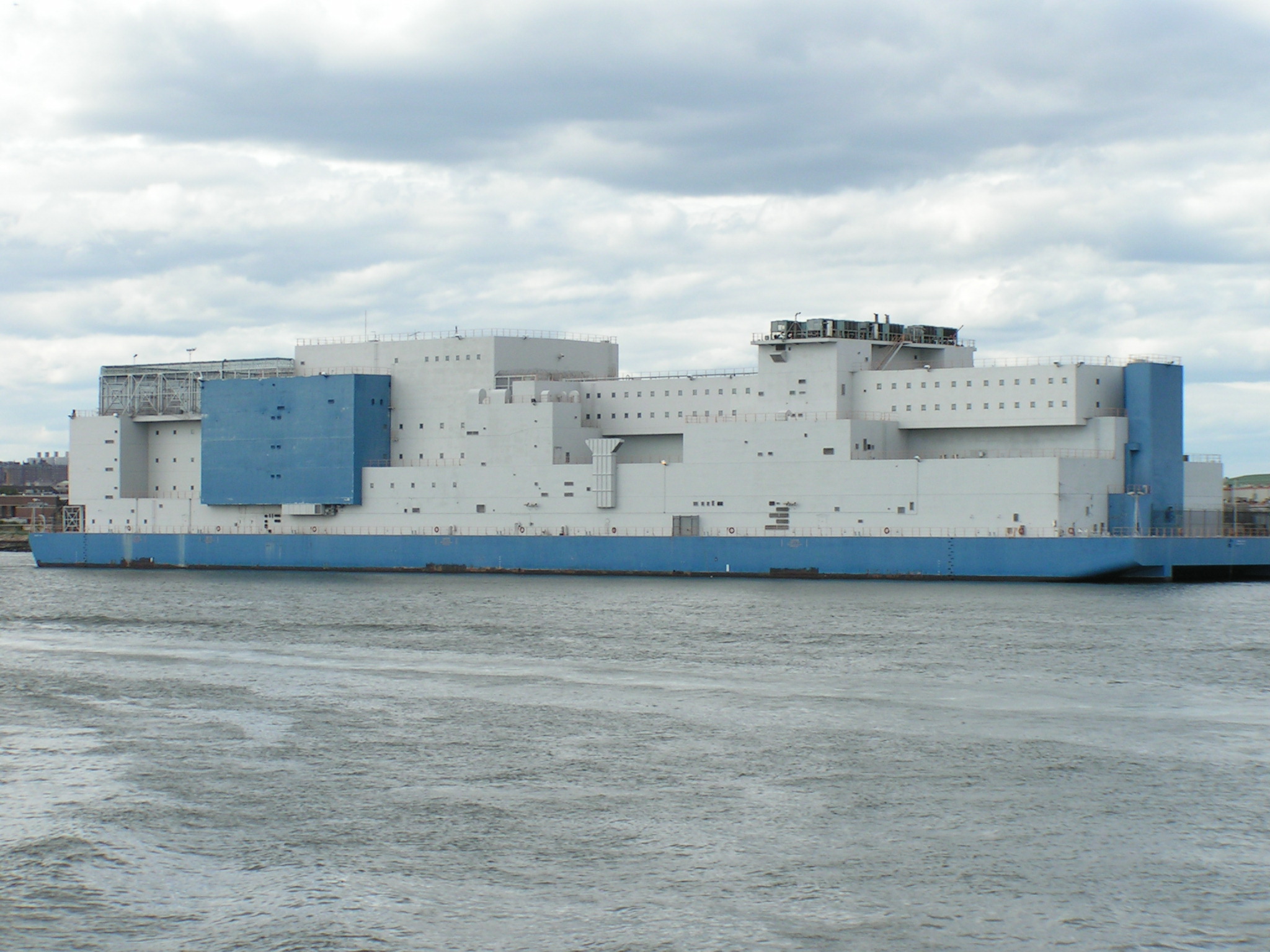
It finally happened. In November 2025, a massive, rusted five-story barge was tugged away from the Bronx shoreline, heading toward a scrap yard in Louisiana. For over thirty years, the Vernon C. Bain Correctional Center sat anchored off Hunts Point, a surreal and grim fixture of the New York City skyline. Locals called it "The Boat." To the people trapped inside, it was something much worse.
Most people don't realize how weird this thing actually was. It wasn't just a boat used as a jail; it was the world’s only purpose-built prison barge. Basically, a floating fortress of steel and sorrow.
Why did NYC build a jail on a barge?
Back in the late 1980s, New York City was in a panic. The "War on Drugs" was in full swing, and the jail population was exploding. Rikers Island was packed to the gills—holding over 22,000 people at one point. The city needed space, and they needed it fast.
Building a new jail on land is a political nightmare. Nobody wants a prison in their backyard. So, the Edward I. Koch administration had a "bright" idea: put them on the water. They bought old troop carriers first, but the Vernon C. Bain Correctional Center was the crown jewel of this plan.
It cost $161 million to build. That’s a lot of money for something that was supposed to be "temporary." It arrived in 1992, eighteen months late and way over budget. It was named after a well-respected warden who died in a car accident, but the facility itself never quite lived up to a respectable reputation.
Life on the Vernon C. Bain Correctional Center
If you’ve ever been on a boat in a storm, you know that rocking feeling. Now imagine feeling that while locked in a cage.
The barge had 16 dormitories and 100 cells. It could hold about 800 inmates. Because it was a boat, it had to follow Coast Guard regulations, meaning it needed a maritime crew—engineers and oilers—on top of the usual corrections officers. This made it incredibly expensive to run, costing the city around $24 million a year just to keep the lights on and the hull floating.
Conditions were, honestly, pretty miserable.
- The Heat: In the summer, the sun beat down on the steel hull, turning the interior into an oven.
- The Isolation: It was tucked away between a wastewater treatment plant and a fish market. Even lawyers had a hard time getting there.
- The Decay: Saltwater is brutal on metal. Over the years, leaks and rust became part of the architecture.
In 2021, a young man named Stephan Khadu died after contracting meningitis on the boat. A year later, Gregory Acevedo jumped off the side of the barge into the East River in a desperate attempt to escape. He didn't survive. These tragedies fueled a massive push from advocates like The Bronx Defenders to shut it down for good.
The 2023 decommissioning and the 2025 removal
The city finally stopped using the Vernon C. Bain Correctional Center to house inmates in October 2023. The last 500 people were moved to Rikers Island, which is a whole other mess, but at least they weren't on a sinking ship anymore.
For two years, it just sat there. A ghost ship.
Then, in late 2025, the city signed a deal with Louisiana Scrap Metal. They paid the city $1.5 million for the barge. It’s kinda ironic—the boat was built in Louisiana, spent thirty years caging people in the Bronx, and now it’s back in the Bayou to be sliced into pieces.
What’s next for Hunts Point?
Now that the "stain on the Bronx" is gone, the city has big plans. They’re calling it the "Hunts Point Marine Terminal."
Basically, they want to turn the old jail site into a shipping hub. It’s part of a "Blue Highways" plan to move freight via water instead of trucks. If it works, it could take thousands of polluting semi-trucks off Bronx streets every year. It’s supposed to create 400 construction jobs and eventually 100 permanent ones.
The legacy of the "Prison Ship"
The Vernon C. Bain Correctional Center remains a symbol of an era when New York chose "temporary" fixes over real reform. It was a $160 million stopgap that lasted three decades.
While the boat is gone, the debate isn't. The city is still legally mandated to close Rikers Island by 2027, though that deadline looks more like a suggestion these days with all the delays. The removal of the barge is a win for the local community, but it’s just one piece of a much larger, much uglier puzzle.
If you’re following the future of NYC’s justice system, here’s what to look for next:
- Land Remediation: The site where the barge was docked has historical contamination from old gas plants. The city has to clean that up before the new terminal can be built, a process expected to last until 2027.
- Borough-Based Jails: Watch the progress on the new facilities in Brooklyn, Queens, Manhattan, and the Bronx. These are meant to replace Rikers, but the first one isn't expected to open until at least 2029.
- Hunts Point Forward: Check the updates on the $40 million investment into the Hunts Point neighborhood to see if the promised "Green Jobs" actually materialize for local residents.
The era of the American jail barge is officially over. Now, the city has to figure out what to do with the people who are still on land.