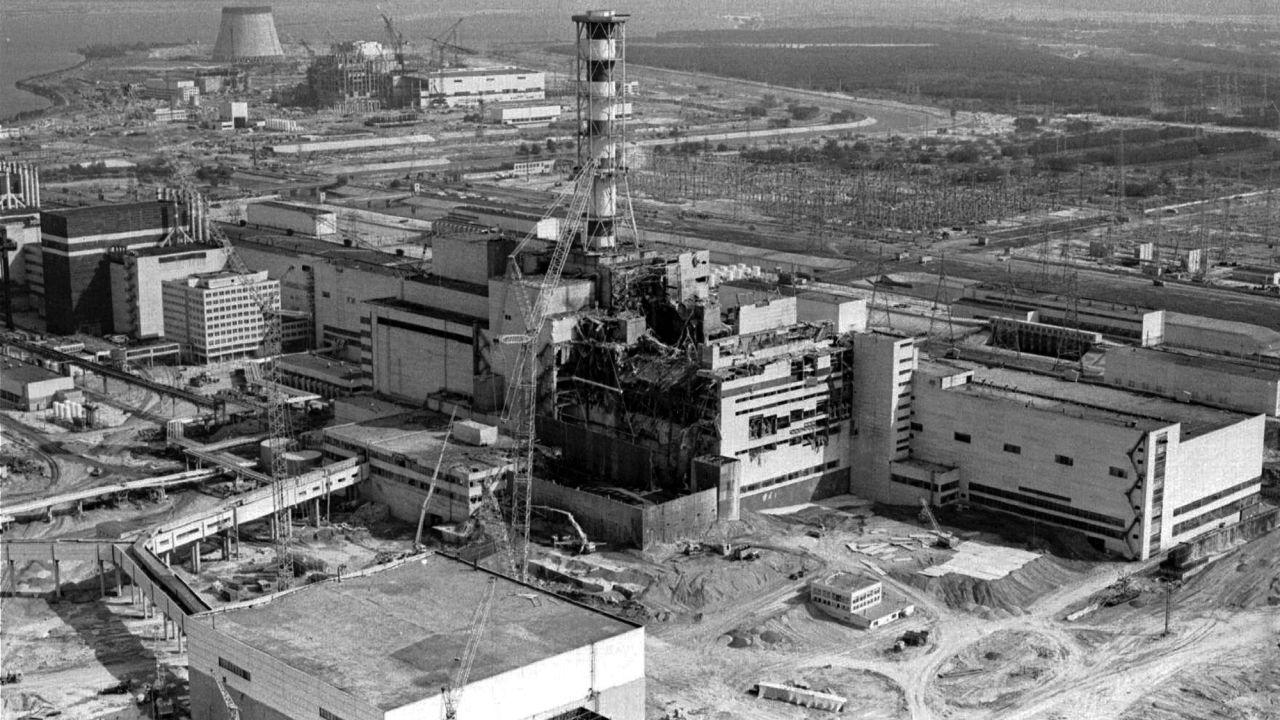
If you head to YouTube right now and type in footage of chernobyl explosion, you’re going to see a lot of grainy, black-and-white clips. You’ll see fire. You'll see smoke billowing into a dark Ukrainian sky. You might even see what looks like a massive gout of blue light shooting toward the stars.
It’s all fake. Well, not fake in the sense that the event didn't happen, but "fake" in the sense that nobody was standing there with a camera at 1:23:45 a.m. on April 26, 1986, waiting for Unit 4 to pop.
The reality is much more haunting.
The Chernobyl disaster wasn't a televised event. It was a secret, then a rumor, then a global catastrophe. Because of the way the Soviet Union handled information—and the way radiation literally destroys camera film—the visual record of that night is a fragmented mess of recreation, post-accident flyovers, and grainy shots taken hours after the core was already exposed to the atmosphere.
The Physics of Why We Can't See the Blast
Cameras and high-level radiation don't get along.
If someone had been standing on the "Bridge of Death" or near the turbine hall with a movie camera during the actual steam explosion, the film would have been ruined. High-energy particles from a ruptured reactor core act like tiny bullets. They pierce the casing of the camera and "fog" the film. You wouldn't see a crisp explosion; you’d see a white, static-filled blur.
Most of what people think is footage of chernobyl explosion is actually taken from the 2019 HBO miniseries or old Soviet documentaries filmed days later.
The first person to really capture the scale of the disaster on film was Igor Kostin. He was a photographer for Novosti Press Agency. He flew over the site in a helicopter about nine hours after the blast. He described the air as feeling "metallic." He tried to take photos, but his camera shutter started jamming because of the intense radioactivity. Out of several rolls of film, only one shot survived the development process. It was grainy, distorted, and weirdly yellow. That wasn't an artistic choice—it was the radiation eating the emulsion.
What Real Footage Actually Looks Like
When you look for authentic archival material, you have to look for the "Liquidators."
These were the men—soldiers, miners, firemen—sent in to clean up the mess. The real footage is terrifying because it's so mundane. You see men running onto the roof of Unit 3 to shovel "hot" graphite back into the hole of Unit 4. They only had 40 to 90 seconds before they hit their lifetime radiation limit.
The film from these sessions is distinctive. Look for the white flashes at the bottom of the screen.
Those aren't glitches in the digital transfer. Those are direct hits from gamma rays hitting the camera's sensor or the film's chemical layer. It's the visual heartbeat of a dying reactor.
The Famous "Elephant's Foot" Video
There is a specific video often confused with the explosion footage. It shows a grainy, shaky POV shot of a remote-controlled camera moving through a dark, debris-strewn hallway. Eventually, it finds a mass of black, lava-like sludge. This is the Elephant's Foot, a hunk of corium so radioactive that even years later, spending a few minutes next to it was a death sentence.
Again, this was filmed long after the fires were out.
Misconceptions and the "Blue Flash"
In almost every dramatization, including the big-budget ones, the explosion is shown as a massive, fiery column. Witnesses like Alexander Yuvchenko, who was on duty that night, did report seeing a "shimmering" pillar of ionized blue light reaching into the sky.
This is a real phenomenon called Cherenkov radiation.
It happens when charged particles move through a medium (like air or water) faster than the speed of light in that medium. It creates a blue glow. But here is the catch: because it’s a faint light effect, and the explosion happened in a split second amidst a cloud of steam and dust, no camera captured it.
If you see a crisp, clear video of a blue beam shooting out of a building, you're watching CGI. Honestly, the real accounts from the workers in the control room are way scarier than any TikTok edit. They talked about the floor shaking like an earthquake and the 500-ton biological shield—the "lid" of the reactor—simply jumping up and down before the roof blew off.
The First News Reports
The world didn't even know it happened for two days.
The first "footage" the public saw wasn't from Pripyat. It was a short segment on Vremya, the Soviet news program. They showed a still photo of the plant and basically said, "An accident has occurred, and measures are being taken."
It wasn't until Swedish sensors at the Forsmark Nuclear Power Plant detected high levels of radiation on the clothes of their own workers that the USSR was forced to admit the scale of the problem. By then, the "footage" being captured was mostly from Western satellites showing a thermal hotspot where a building used to be.
How to Spot Fake Footage
Since 1986, several films have used the disaster as a backdrop. This has led to a massive amount of "found footage" style hoaxes.
- Check the frame rate: True 1980s Soviet film (16mm or 35mm) has a specific jitter. Digital filters usually look too smooth.
- The "Scare" Factor: Authentic footage of the aftermath is usually silent or has the dull roar of a helicopter. If there is dramatic orchestral music, it’s a documentary or a movie.
- The Colors: Real footage from the site is often washed out. If the grass looks vibrant green and the sky is a perfect blue, it’s probably modern drone footage of the Exclusion Zone, not historical records from the 80s.
Vladimir Shevchenko was another filmmaker who went in early. His film, Chernobyl: Chronicle of Difficult Weeks, is arguably the most important piece of media from the era. He died of radiation sickness shortly after. He knew the risks, but he kept filming because he knew the world wouldn't believe it otherwise.
Why This Still Matters
The obsession with finding footage of chernobyl explosion speaks to our need to witness the "unwitnessable."
It was a turning point in human history where our technology outpaced our ability to control it. Seeing the explosion would feel like seeing the face of a monster. But the monster was invisible. It was in the dust, the water, and the wind.
Today, you can go to the Exclusion Zone. You can take a drone and fly it over the New Safe Confinement. You can see the rusting ferris wheel. But you will never see the moment the core opened up. That moment exists only in the memories of the people who were there—most of whom are no longer with us.
Actionable Steps for Researching Chernobyl History
If you want to see the most authentic visual records of the disaster without falling for CGI hoaxes, follow these steps:
- Seek out the "Shevchenko" Archives: Search specifically for the work of Vladimir Shevchenko. His footage contains the actual "static" caused by radiation interference.
- Verify via the National Museum of the Chornobyl Disaster: This museum in Kyiv holds the most extensive collection of verified photographs and film strips taken by liquidators.
- Cross-Reference with Satellite Data: Use declassified CIA or European satellite imagery from late April 1986 to see the thermal progression of the fire.
- Distinguish Between "The Zone" and "The Event": Understand that 99% of the footage available online is of the abandoned city of Pripyat as it looks now, not the accident itself.
- Read Witness Testimony: Since the footage doesn't exist, read Voices from Chernobyl by Svetlana Alexievich. It provides the "visuals" that cameras couldn't capture through the words of those who saw the air glow.