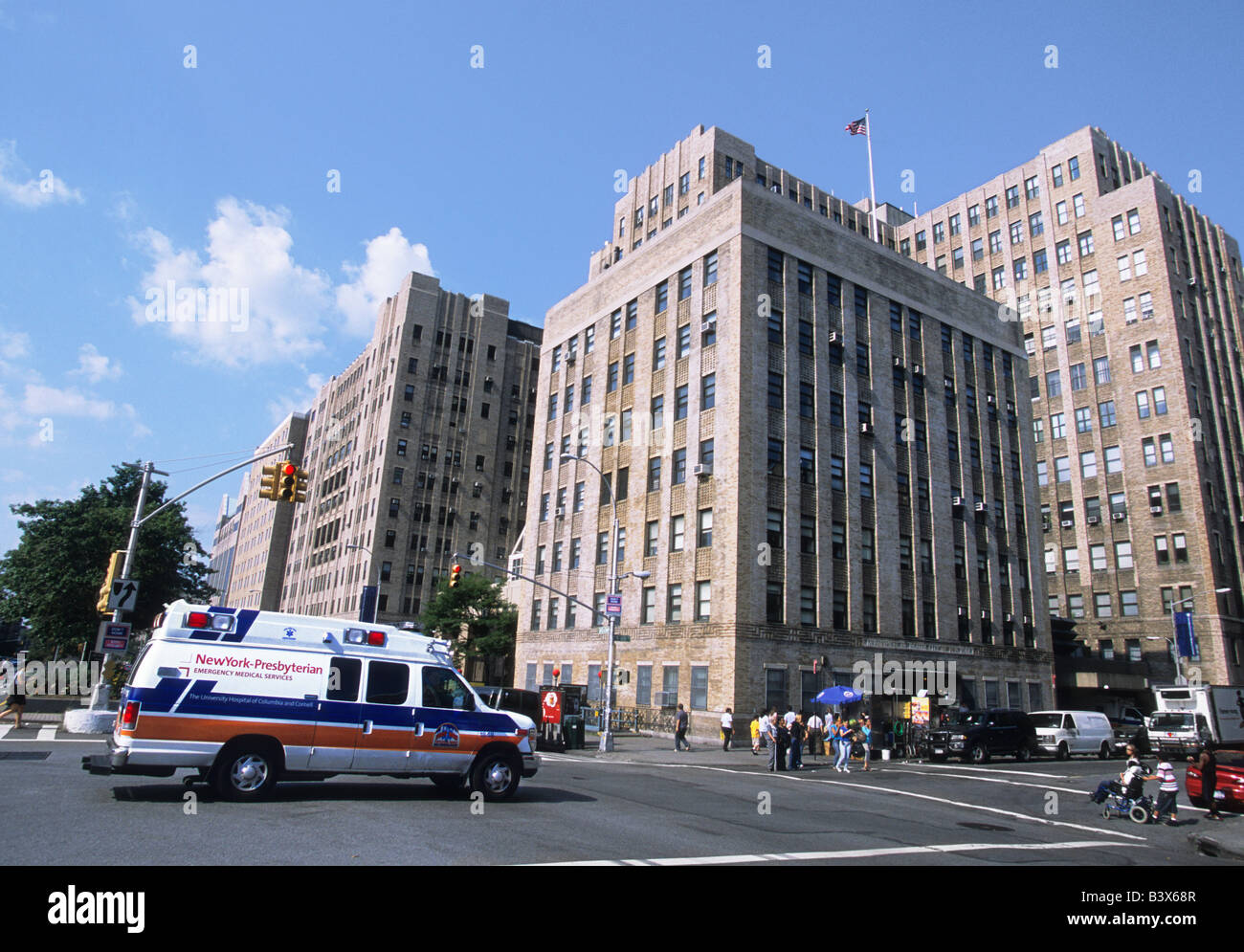
If you’ve ever walked down 168th Street in Washington Heights, you know the feeling. The wind whips off the Hudson River, and suddenly, you’re standing in the shadow of a literal city within a city. New York Columbia Presbyterian—officially known as New York-Presbyterian/Columbia University Irving Medical Center—isn't just a building. It's a massive, sprawling organism of glass, brick, and some of the smartest medical minds on the planet. Honestly, it’s intimidating. But it’s also where some of the wildest medical "firsts" actually happened.
People call it "Columbia" for short, or "NYP." Whatever name you use, the reputation is the same. It's high-stakes.
Most hospitals are just places you go when you’re sick. This place is different. It’s a research powerhouse. It’s where the Apgar score—that test every single baby gets the second they're born—was invented by Dr. Virginia Apgar. It’s where the first successful pediatric heart transplant took place. When you walk through those doors, you aren't just getting a check-up; you're entering a place that has quite literally redefined what it means to stay alive.
But let’s be real for a second. Navigating it is a nightmare. You will get lost.
The Reality of Getting Care at New York Columbia Presbyterian
Let’s get the logistics out of the way because that’s what people actually search for when they're stressed out. New York Columbia Presbyterian sits right at the intersection of Ivy League academia and gritty NYC reality. It serves the local Dominican community in Upper Manhattan while simultaneously flying in royalty and CEOs from across the globe. That contrast is everywhere. You’ll see a world-renowned surgeon grabbing a coffee next to a family who has lived in the Heights for forty years.
It’s big. Like, really big.
The main campus is the Milstein Hospital Building. If you're there for heart surgery or a major procedure, that’s likely where you’ll land. Then you’ve got the Morgan Stanley Children’s Hospital, which is genuinely one of the best pediatric centers in the world. They have a child life program that actually makes the place feel less like a sterile lab and more like a space where kids can, well, be kids.
Wait times? Yeah, they exist. It’s a Tier 1 trauma center in the middle of New York City. If you go to the ER for a minor scrape, you’re going to be waiting behind people with life-altering injuries. That’s just the trade-off for being at a place that handles the hardest cases in the country.
Why the Heart Center is a Big Deal
If there is one thing New York Columbia Presbyterian is "famous" for in the medical world, it’s the heart stuff. The Columbia HeartSource program is legendary.
They don't just do "standard" bypasses. They are the ones developing the technology for TAVR (Transcatheter Aortic Valve Replacement), which basically allows doctors to fix a heart valve via a small catheter rather than cracking someone's chest wide open. For an eighty-year-old patient who can't handle major surgery, that isn't just "cool tech." It's the difference between going home or not.
Dr. Mehmet Oz used to be a fixture here before he became a household name. Regardless of what you think of his TV persona, the surgical department he was part of remains one of the most mechanically advanced in the Western Hemisphere. They do more heart transplants than almost anywhere else.
But it’s not just about the "superstars." It’s about the nurses and the residents who are pulling 80-hour weeks.
The intensity is palpable.
The Connection Between Columbia University and the Hospital
You can’t talk about the hospital without talking about the "Columbia" part. This is the Vagelos College of Physicians and Surgeons. The doctors here are also professors. They are the ones writing the textbooks that other doctors read.
This means two things for a patient:
- You might have a group of four medical students trailing your doctor during rounds. It can feel a bit like being a specimen under a microscope.
- You have access to clinical trials that simply don't exist in suburban hospitals.
If you have a rare form of cancer or a neurological disorder that has stumped every other doctor, this is where you go. They have the Herbert Irving Comprehensive Cancer Center. They are doing things with immunotherapy and CRISPR gene editing that feel like science fiction.
Is it "colder" than a small community hospital? Sometimes. Academic medical centers are focused on data and outcomes. You might not get as much "hand-holding" as you would at a boutique private clinic in Midtown, but you are getting the collective brainpower of some of the highest-IQ individuals in medicine.
Neurological Institute: The Brain Trust
Right across from the main hospital is the Neurological Institute of New York. It was the first of its kind in North America. If you’re dealing with something like Parkinson’s, ALS, or complex epilepsy, this is the mecca.
They use specialized PET imaging and intraoperative MRI that sounds like something out of a Marvel movie. They can map a brain while the patient is still awake to ensure they aren't hitting critical speech centers during a tumor removal.
It’s intense work.
Honestly, the building itself looks a bit dated in parts—it’s got that old-school NYC institutional vibe—but the tech inside is 2026-level.
What People Get Wrong About the "Presbyterian" Part
A common misconception is that you have to be religious to go there or that the care is somehow dictated by church doctrine.
Nope.
The "Presbyterian" name comes from the 1998 merger between The Presbyterian Hospital and New York Hospital. It’s a legacy name. Today, the system is officially New York-Presbyterian, and it includes several campuses like Weill Cornell on the East Side.
While the Columbia campus (the one in Washington Heights) and the Cornell campus (the one on 68th Street) are part of the same "NYP" umbrella, they are staffed by two different Ivy League medical schools.
The "Columbia" side is often seen as more "hardcore" research-focused and serves a much more diverse, urban population. The Cornell side is often perceived as more "polished." Both are world-class, but the vibe at New York Columbia Presbyterian is distinctly "Upper Manhattan." It’s busy. It’s loud. It’s brilliant.
Facing the Challenges: The Patient Experience
Look, no hospital is perfect. If you read the reviews for New York Columbia Presbyterian online, you’ll see a mix of "they saved my life" and "I sat in the waiting room for six hours."
Both are true.
The sheer volume of patients is staggering. Dealing with the billing department can be a headache because the system is so massive. Navigating the different wings—the Atchley Pavilion, the Harkness Pavilion, the Milstein Building—requires a GPS and a lot of patience.
There is also the "private vs. ward" reality. Like many legacy New York institutions, some of the older wings have rooms that feel cramped. If you’re lucky enough to be in a newer suite in Milstein with a view of the George Washington Bridge, it feels like a hotel. If you’re in an older section, it feels like 1974.
But you don't go to Columbia for the wallpaper. You go because you want the surgeon who has done the procedure 5,000 times.
Practical Tips for Patients and Visitors
If you find yourself headed there, here is the "non-corporate" advice:
- The Subway is your friend. Take the A, C, or 1 train to 168th Street. Parking in Washington Heights is a nightmare, and the hospital garages are expensive enough to make your eyes water.
- Bring an advocate. Because it’s a teaching hospital, you will see a lot of different faces. Having a family member or friend to keep track of what each doctor said is crucial.
- The Food Situation. The hospital cafeteria is... fine. But you are in Washington Heights! Step outside and grab some mofongo or a solid cup of Dominican coffee. It’ll do more for your soul than a soggy sandwich from a vending machine.
- MyNYP App. Seriously, download it. It’s the only way to keep track of your labs and appointments in a system this big.
The Future of New York Columbia Presbyterian
They aren't slowing down. As we move further into 2026, the focus has shifted heavily toward "precision medicine." This means they are looking at your specific genetic code to decide which chemotherapy will work, rather than just using a one-size-fits-all approach.
They are also expanding their reach into the community. For a long time, there was a bit of a "tower on the hill" vibe where the hospital felt separate from the neighborhood. That's changing. They have more outreach programs now for diabetes and hypertension specifically targeted at the local community. It’s about time.
Why It Matters
In a world where healthcare is becoming increasingly consolidated and corporate, New York Columbia Presbyterian remains a bit of a titan. It is a place of extremes. Extreme stress, extreme innovation, and extreme hope.
It’s where people go when they’ve been told "there’s nothing else we can do."
It’s where a team of thirty people will spend twenty hours in an operating room to separate conjoined twins or transplant a liver into a tiny infant.
It’s not perfect. It’s crowded. It’s expensive. It’s New York.
But if you need the best of the best, there really isn't anywhere else like it.
Actionable Steps for Navigating Your Visit
If you are planning a procedure or a consultation at New York Columbia Presbyterian, do not just show up and hope for the best. The system is too large for a passive approach.
First, verify exactly which building your appointment is in. "The hospital" is actually about a dozen different buildings spread across several city blocks. Confirm the "wing" and "floor" specifically.
Second, request a "Patient Navigator." These are staff members whose entire job is to help you through the maze of a complex diagnosis. They are an underutilized resource that can make your experience 100% smoother.
Third, if you are traveling from out of town, ask the department about "Harkness House" or nearby patient housing. They have arrangements with local hotels for discounted rates for families of long-term patients.
Finally, make sure your primary care physician has established a direct line of communication with the Columbia specialist. In a system this big, information can sometimes get siloed. Being your own "data manager" by keeping a physical folder of your recent scans and labs ensures nothing gets lost in the shuffle of the electronic health record.