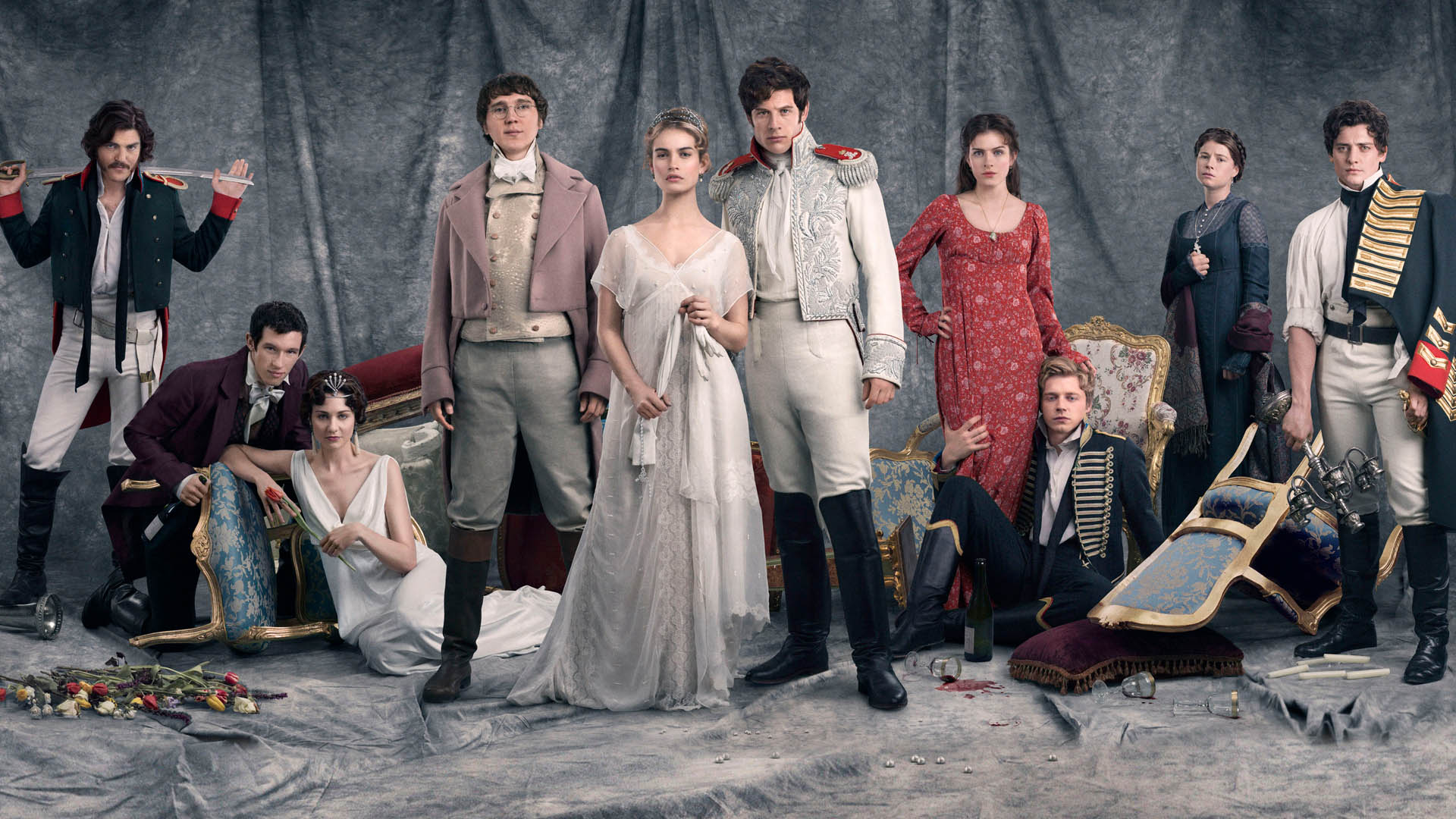
Big books are scary. Leo Tolstoy’s War and Peace is the final boss of scary books, sitting at over 1,200 pages with enough characters to fill a small football stadium. People buy it to look smart on subways, but they rarely finish it. Then came the 2016 War and Peace miniseries.
The BBC took a massive gamble. They handed the script to Andrew Davies—the guy who basically invented the "wet shirt" Mr. Darcy moment in the 90s—and told him to make 19th-century Russian philosophy sexy. It worked. Honestly, it worked better than it had any right to.
It wasn't just another dry period piece. It felt alive.
The sheer scale of the 2016 War and Peace production
Most TV shows fake it. They use tight shots and CGI crowds to make a budget stretch. But for this version of 2016 War and Peace, the production team actually went to Russia. They filmed in the Catherine Palace in St. Petersburg. They stood in the real ballrooms where these historical figures would have danced.
You can feel that weight.
When Paul Dano walks through a field as Pierre Bezukhov, he isn't on a backlot in Burbank. He’s in the mud. The series captures that specific, crushing Russian winter that ruined Napoleon’s dreams. It’s cold. You can almost feel the frostbite through the screen.
Director Tom Harper didn't want it to look like a museum. He used handheld cameras during the battle scenes. It’s chaotic. It’s messy. It’s exactly how Tolstoy described the fog of war—where nobody really knows what’s happening and everyone is just trying not to die.
Paul Dano was the secret weapon
Pierre is a hard character. In the book, he’s this bumbling, oversized, socially awkward intellectual who inherits a fortune and has no idea what to do with his life. He’s us. He’s the person at the party who accidentally breaks a vase and then tries to talk to you about the meaning of existence.
Dano plays him with this incredible, quiet vulnerability.
Most actors would have made Pierre a caricature. Dano makes him the soul of the 2016 War and Peace experience. Watching his journey from a naive kid to a man who has seen the literal end of the world in the burning streets of Moscow is the backbone of the whole six-hour run.
Why some fans (and historians) got grumpy
You can't adapt Tolstoy without making people mad. It’s a rule of the universe.
One of the biggest complaints about the 2016 War and Peace was the "sexing up" of certain plotlines. Specifically, the relationship between Hélène Kuragina and her brother Anatole. In the book, Tolstoy heavily implies they have an incestuous bond, but he keeps it in the shadows. Davies put it front and center.
Critics called it "Downton Abbey-fication."
Maybe they have a point. But let’s be real: Tolstoy wrote for a serialized magazine. He was the soap opera king of his day. He loved drama. He loved scandal. By leaning into the messiness of these aristocrats, the 2016 version actually captured the spirit of the original text better than the stuffier 1956 or 1967 versions. It made the stakes feel personal.
The pacing struggle
The book is slow. Tolstoy will stop the plot for fifty pages just to talk about his theories on history and why "Great Men" don't actually exist.
The 2016 War and Peace throws most of that out.
If you’re a philosophy student, you might hate that. If you’re a viewer who wants to understand why Natasha Rostova is breaking everyone’s hearts, you’ll love it. The show focuses on the "Peace" far more than the "War," highlighting the domestic tragedies that happen while the world is on fire.
The visual language of 19th-century Russia
Lily James as Natasha Rostova is lightning in a bottle.
She starts the series as this literal child, running through hallways, and ends it as a woman who has been shattered and put back together. The costume design reflects this perfectly. The bright, airy silks of the early episodes give way to heavy, dark wools as the Napoleonic wars grind the country down.
It’s about the loss of innocence.
The Battle of Borodino in the series is a masterpiece of television budgeting. They used 500 extras, but they made it look like 50,000. It’s brutal. It’s not "heroic" in the way Hollywood usually does war. It’s just blood in the dirt and the sound of horses screaming.
Comparison: 2016 vs. the Bondarchuk Epic
If you want to be a real cinephile, you have to talk about the 1966 Soviet version directed by Sergei Bondarchuk. That one had the actual Soviet Army as extras. It was seven hours long. It was massive.
The 2016 War and Peace doesn't try to compete with that scale.
Instead, it competes on intimacy. It focuses on the faces. The way James Norton (as Prince Andrei) looks at the sky while he’s lying wounded on the battlefield. That’s the "Tolstoy moment." The realization that the sky is huge and beautiful and our wars are tiny and stupid.
Lessons we can actually take from the 2016 War and Peace
Look, history repeats itself. That’s the whole point of the book and the series. People in 1812 thought they were at the peak of civilization, then everything burned.
Life is unpredictable. Pierre starts with nothing, gets everything, loses his mind, and finds peace in a prison camp. The lesson? Don't get too attached to your current status.
Forgiveness is a superpower. The scene where Andrei forgives Anatole—the man who ruined his life—while they are both in a medical tent is one of the most powerful moments in TV history. It’s not about being "nice." It’s about letting go of the poison so you can die (or live) with a clear head.
The "Great Man" theory is a lie. Napoleon is portrayed not as a genius, but as a guy who got lucky until he didn't. The real power in the 2016 War and Peace lies in the collective spirit of the people who just keep moving forward, planting crops and falling in love, even when the world is ending.
If you haven't watched it yet, do it for the cinematography alone. If you have watched it, go back and look at the scenes with Marya Bolkonskaya. Her storyline is the most underrated part of the whole production—a quiet study in endurance.
To get the most out of the experience, watch it in two-episode chunks. Don't binge it all at once. Let the gloom of the Russian winter settle in. Then, if you’re feeling brave, actually go pick up the book. You’ll find that the faces of Paul Dano and Lily James make those 1,200 pages move a whole lot faster.
The real trick to enjoying 2016 War and Peace is realizing it's not a history lesson. It's a mirror. We're all just Pierre, trying to figure out why we're here while the world changes around us.
Actionable Steps for the Viewer
- Watch the 2016 miniseries first: It provides a visual map of the characters that makes the book significantly easier to follow.
- Focus on the "Big Three": Keep your eyes on Pierre, Natasha, and Andrei. Everyone else is a satellite to their development.
- Compare the endings: The 2016 version takes some liberties with the "Epilogue." Once you finish the show, read the last 50 pages of the book to see how Tolstoy’s actual conclusion is much more cynical (and interesting) regarding marriage and politics.
- Listen to the score: Martin Phipps used Latvian State Choir vocals to create a haunting, liturgical sound. It’s worth a standalone listen on Spotify to understand the "soul" of the production.