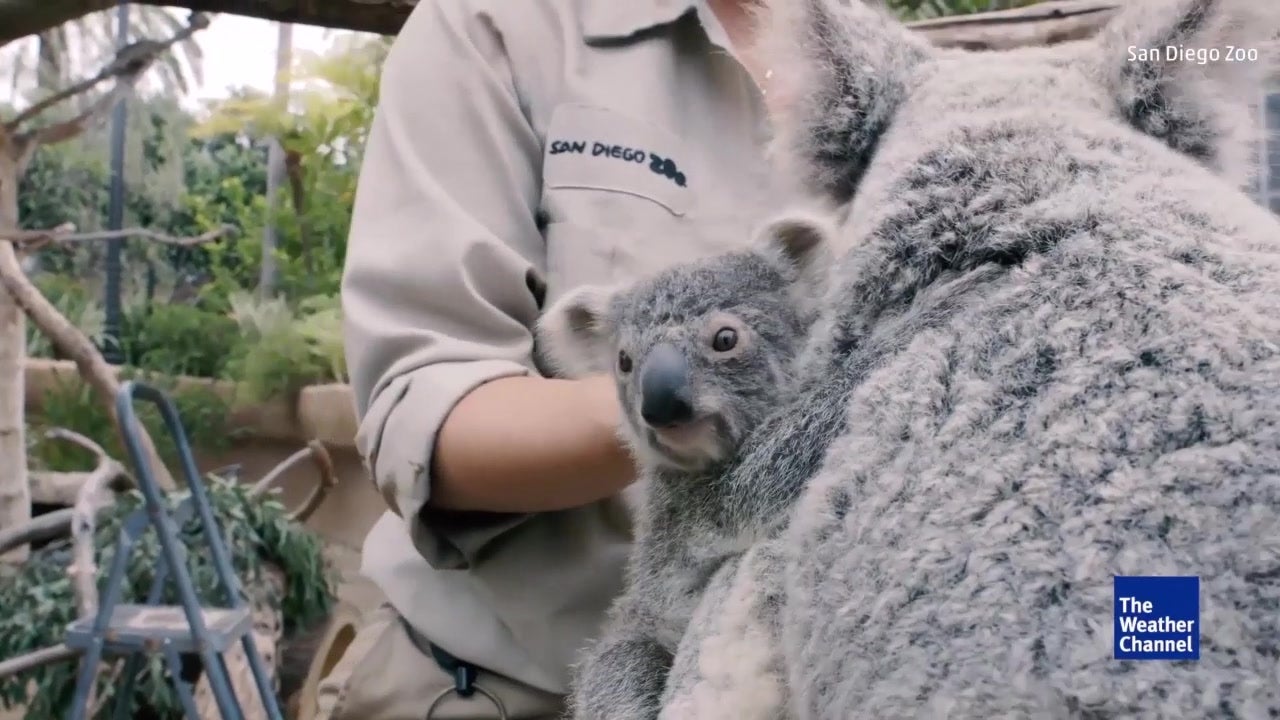
You’ve seen the photos. A fuzzy, oversized head poking out of a grey belly. It’s the quintessential image of the Australian outback. But honestly, the reality of a koala in a pouch is way weirder than the postcards suggest. It’s not just a cozy pocket for a nap. It’s a biological high-stakes survival chamber that functions more like an external womb than a backpack.
Most people think of pouches as upright pockets—basically a hoodie for a kangaroo. Koalas decided to do things differently. Their pouches open toward the rear. If you’re a climber, this makes perfect sense. You don't want a pocket full of baby hitting every branch as you scramble up a towering Eucalyptus punctata. But it also means the "joey" (the term for the infant) is basically staring at its mom's heels for months. It’s cramped. It’s messy. And the transition from that pouch to the big, scary world of toxic leaves is one of the most disgusting, yet fascinating, processes in nature.
The Brutal First Journey of the Koala in a Pouch
Let’s talk about the birth. It’s not pretty.
After only about 30 to 35 days of gestation, the baby is born. It is the size of a jellybean. It’s pink, hairless, and completely blind. It doesn't even have fully formed hind legs. At this stage, the koala in a pouch hasn't even reached the pouch yet. It has to climb. Using nothing but its tiny front claws and a raw instinct for survival, this bean-sized creature crawls through a thicket of fur to find the opening.
Imagine being an inch long and having to navigate a vertical forest of hair while blind. It’s a miracle they make it. Once inside, the joey latches onto one of two teats. The teat then swells inside the joey's mouth, essentially locking it in place. It isn't going anywhere for the next six months. It stays anchored. It grows. It develops ears, eyes, and that signature velvet fur, all while tucked away in a rear-facing nursery.
Why the Rear-Opening Pouch Matters
Evolution doesn't usually make mistakes, but a backward-facing pouch seems like a design flaw at first glance. Why would you put the exit right near the "exhaust pipe"?
For a tree-dwelling marsupial like the Phascolarctos cinereus, a front-facing pouch would be a nightmare. Koalas spend their lives wedged into the forks of trees. If the pouch opened at the top, it would fill with bark, debris, and rain. More importantly, the muscular ring (the sphincter) that keeps the pouch closed is incredibly strong. The joey isn't just falling out.
Dr. Stephen Johnston, a reproductive biologist at the University of Queensland, has noted that this anatomy is likely a carryover from the koala’s burrowing ancestors. Wombats have the same setup. If you’re digging in the dirt, you don't want to shovel soil into your baby’s face. Koalas just kept the blueprint when they moved into the canopy.
The Secret Ingredient: Pap
This is where things get a bit "gross" for the average human. Around the six-month mark, the koala in a pouch needs to start eating eucalyptus. But there’s a massive problem. Eucalyptus leaves are incredibly toxic. They are loaded with phenols and terpenes that would kill most other mammals. Adult koalas have specialized gut bacteria to break these toxins down, but a joey's gut is a blank slate.
To fix this, the mother produces something called "pap."
It’s not milk. It’s not quite feces, either. It’s a specialized form of soft, liquefied droppings that come directly from the mother’s caecum. It’s rich in the microbes the joey needs to survive. The joey leans out of the rear-facing pouch and eats this "pap" for several weeks.
It’s nature’s ultimate probiotic.
Without this step, the joey could never transition to eating leaves. It would starve or be poisoned by its own dinner. This "pap" phase is the only time the backward-facing pouch looks like a genuine stroke of genius—the joey has a direct line to the pharmacy.
Life Inside the Pocket
Space is at a premium. By the time a joey is seven or eight months old, it's getting way too big for its living quarters. You’ll often see a koala in a pouch where the only thing visible is a stray leg or a flattened ear. The mother's skin stretches significantly to accommodate the growing weight.
- Month 1-6: Total seclusion. The joey is basically an extension of the mother’s internal organs.
- Month 6-7: The first "lookout." Eyes open. The joey starts poking its head out to sniff the wind.
- Month 8-9: The "backpacker" phase. The joey spends more time riding on the mother’s back than inside the pouch, though it still ducks back inside to sleep or drink milk.
Interestingly, the milk changes. As the joey ages, the nutritional composition of the mother’s milk shifts to provide more fats and proteins. It’s a dynamic feeding system that responds to the joey’s developmental milestones.
The Threats Nobody Talks About
We like to think of the pouch as a safe haven, but it’s vulnerable. One of the biggest threats to a koala in a pouch in modern Australia is Chlamydia. No, it’s not exactly like the human version, but it’s devastating. It can cause blindness, infertility, and "dirty tail" (a severe urinary tract infection).
When a mother is infected, she can pass the bacteria to the joey during the "pap" feeding stage. This is a massive issue for conservationists. If we can't treat the mothers, the joeys are born into a cycle of disease before they even leave the pouch. Research centers like the Lone Pine Koala Sanctuary are constantly working on vaccines, but the logistics of vaccinating wild populations are a nightmare.
Then there’s the heat. Australia is getting hotter. Koalas don't sweat like we do. They lose heat through their breath and by hugging cool trees. Inside a fur-lined pouch, a joey can easily overheat during a 45°C heatwave. Moms will often seek out the lowest, coolest branches of a tree to keep the pouch temperature regulated.
Misconceptions and Myths
People often ask if you can "foster" a joey. The answer is: only if you're a trained professional with 24-hour availability. A joey that has been separated from the koala in a pouch environment requires a very specific humidified environment and specialized milk formulas (like Wombaroo).
Another myth? That they’re "high" on eucalyptus leaves. They aren't. They’re just exhausted. Eucalyptus has almost no nutritional value. It takes a lot of energy to digest poison, so koalas sleep up to 20 hours a day just to save calories. The joey in the pouch is doing the same—growing a brain and a body on a shoestring energy budget.
Protecting the Future of the Joey
If you ever find a koala on the ground or a mother that has been hit by a car, the first thing rescuers check is the pouch. Joeys often survive impacts that kill the mother because the pouch acts like a natural airbag.
If you want to help, support organizations like the Australian Koala Foundation (AKF). They focus on habitat protection rather than just individual rescue. Because at the end of the day, a koala in a pouch won't survive if there aren't any trees left for it to climb once it finally decides to come out.
Actionable Next Steps for Koala Conservation:
- Check for Pouches: If you find a deceased koala near a roadway, never assume it’s alone. Check for a pouch or a small joey nearby. Call local wildlife authorities (like WIRES in NSW) immediately.
- Support Habitat Corridors: Use tools like the Koala Habitat Atlas to see if you live in a sensitive area. Planting the right species of eucalyptus (it varies by region!) can provide essential food for future generations.
- Keep Dogs Leashed: Most joey fatalities occur when the young koala first starts exploring the ground. If you live in a koala-prone area, keep pets inside at night when koalas are most active.
- Advocate for Wildlife Overpasses: Contact local councils to support the construction of wildlife bridges. These prevent mothers—and their precious cargo—from having to cross dangerous roads.
The journey of a koala in a pouch is a feat of biological engineering. From the first blind crawl to the "pap" buffet, it’s a grueling start to life that produces one of the world’s most specialized survivors. Respect the pouch—it’s doing a lot more work than it looks.