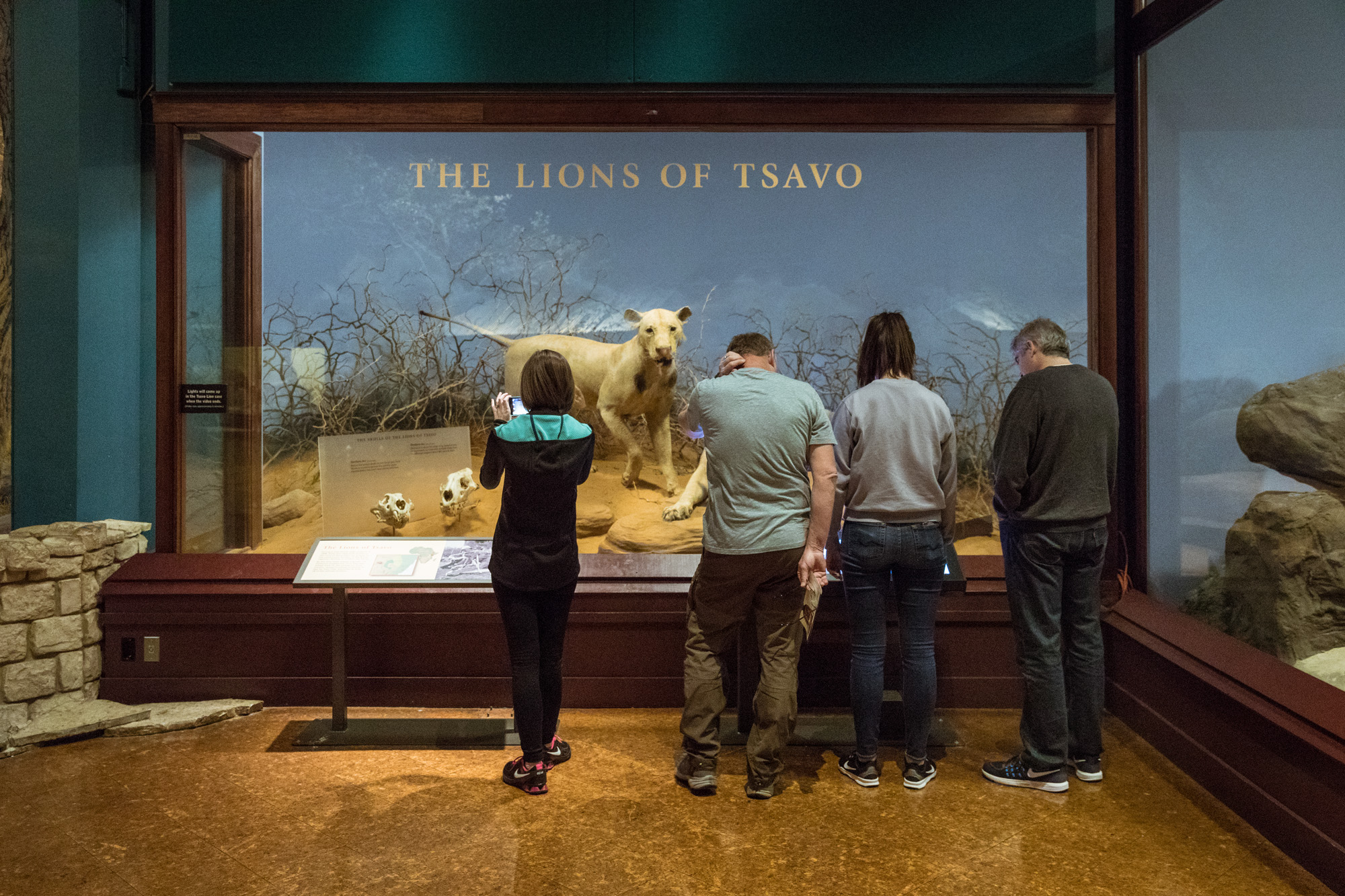
Walk into the Field Museum in Chicago, past the towering skeleton of Máximo the Titanosaur, and you’ll eventually find a glass case that feels different from the rest. It’s quiet there. Inside stand two lions. They aren't the majestic, maned creatures you see on National Geographic. They’re kind of scruffy. They lack manes entirely. Their skin looks stretched, weathered by over a century of preservation and a life of brutal survival in the Kenyan bush. These are the Lions of Tsavo Chicago Field Museum residents, and honestly, they are probably the most famous man-eaters in human history.
In 1898, these two lions brought the British Empire’s railroad expansion to a grinding halt. For nine months, they terrorized a bridge-building camp over the Tsavo River. It wasn't just a few isolated attacks. It was a calculated, persistent siege. The British were trying to link Mombasa to Lake Victoria—the "Lunatic Line," they called it—but the lions had other plans.
Workers were snatched from their tents in the middle of the night. Thorns were piled high into "zerebas" (defensive enclosures) to keep the beasts out, but the lions just jumped over them or crawled through. They dragged men into the darkness while their campmates listened to the horrific sounds of the aftermath. It’s the stuff of nightmares, and it’s all real.
What Really Happened at the Tsavo River Bridge
Most people know the Hollywood version from The Ghost and the Darkness. Val Kilmer plays Colonel John Henry Patterson, the Irish engineer sent to get the project back on track. While the movie gets the tension right, the reality was much grittier. Patterson was a hunter, sure, but he was mostly a frustrated project manager trying to stop a mass desertion of his workforce.
The lions killed dozens. Patterson claimed 135 people died. The Field Museum’s later isotopic analysis of the lions' bone and hair suggests a lower number—likely around 35 victims—but that doesn't account for the "scare factor" or the possibility that the lions ate more than just humans. Regardless of the exact body count, the psychological toll was massive.
Patterson finally shot the first lion on December 9, 1898. He got the second one three weeks later. It took multiple shots from his .303 Lee-Enfield to bring them down. These weren't "normal" lions. They were huge, measuring nearly ten feet from nose to tail. After the kills, Patterson didn't give them to a museum immediately. He kept them as floor rugs.
For 25 years, the Lions of Tsavo Chicago Field Museum stars were literally being stepped on in Patterson's house. By the time the Field Museum bought them in 1924 for $5,000, they were in rough shape. Taxidermist Leon Pray had to work miracles to reconstruct them. He built internal mannikins and stretched the worn skins over them, which explains why they might look a bit smaller or "flatter" than you’d expect from a wild lion.
The Mystery of the Manelessness
If you look at the lions today, you’ll notice they don't have that iconic circular mane. People used to think they were young or sick. Neither is true.
Tsavo is hot. Insanely hot. A thick mane is basically a wool sweater you can’t take off. Evolution figured out that in the thorny scrub of Tsavo, a mane is a liability. It gets caught on things. It holds heat. Most male lions in that specific region of Kenya are still maneless or have very sparse manes today. It’s an environmental adaptation.
The Lions of Tsavo Chicago Field Museum display actually helped scientists understand this variation in lion biology. It wasn't a deformity; it was a survival strategy.
Why Did They Eat Humans?
This is the big question everyone asks when they see the exhibit. Lions don't usually hunt people. We’re bony, we’re weird, and we’re loud. Usually, a lion only turns to "human prey" when something is wrong.
For a long time, the "Rinderpest" theory was the leading explanation. A plague had wiped out the lions' usual food source—cattle and buffalo—forcing them to look elsewhere. Then there was the burial practice theory. Hindu funeral rites for the railway workers involved leaving bodies out, which might have given the lions a "taste" for human flesh.
However, in the early 2000s, researchers like Dr. Bruce Patterson (no relation to the Colonel) took a closer look at the lions' teeth. The results were telling.
- The first lion had a massive abscess at the root of one of its canine teeth.
- This would have made it incredibly painful to take down a struggling 1,000-pound buffalo.
- Humans are slow. We don't have horns. We’re basically "soft" prey.
The lions weren't "evil" or "ghosts." They were injured, opportunistic predators. They found a buffet of thousands of workers concentrated in one spot and took the path of least resistance. It’s a sobering reminder that nature doesn't care about our industrial progress; it only cares about calories.
The Isotopic Evidence
Science is getting better at reading the past. By analyzing the nitrogen and carbon isotopes in the lions' remains, researchers at the Field Museum and UC Santa Cruz could tell what these animals ate in their final months.
The data showed that "Lion 1" (the one with the tooth ache) had eaten about 11 humans. "Lion 2" had eaten about 24. This confirms they weren't just killing for sport; they were consuming the victims. It also shows a weird partnership where one lion seemed more specialized in hunting humans than the other. They were a team.
Visiting the Field Museum Today
If you’re planning a trip to see the Lions of Tsavo Chicago Field Museum, you’ll find them in the Rice Hall of Mammals. They aren't in a flashy, high-tech interactive zone. They’re in a classic wood-and-glass case.
There is something haunting about looking into the glass eyes of creatures that once caused a global empire to stop its tracks. You can see the scars on the hides. You can see the lack of manes. It’s a very visceral experience that connects you to a specific, terrifying moment in 1898.
The museum has done a great job of balancing the "thriller" aspect of the story with actual conservation science. While the lions are the draw, the exhibit forces you to think about human-wildlife conflict. As humans continue to push into wild spaces, the story of Tsavo isn't just a history lesson; it’s a recurring reality in many parts of the world.
What Most People Get Wrong
People often expect to see "monsters." They expect these massive, fluff-filled beasts. When they see the actual specimens, they sometimes feel underwhelmed because the taxidermy is old and the lions are maneless.
But that’s the point. They aren't movie monsters. They were real animals. The fact that they look "normal" is what makes the story scarier. It’s the reality of the African savannah, not a Hollywood set.
Also, don't confuse them with the "Mfuwe Man-Eater." That’s a different lion, also at the Field Museum, which was even larger and killed several people in Zambia in 1991. The Field Museum is basically the world capital for famous man-eating cats.
How to Get the Most Out of Your Visit
Don't just walk by. Take a second. Read the original telegrams displayed nearby. Look at the photos of the bridge under construction.
- Check the teeth: If you look closely at the first lion, you can see the dental damage that likely triggered the whole ordeal.
- Compare the hides: See if you can spot the repair marks where the rugs were turned back into mounts.
- Visit the gift shop: They usually have copies of Patterson's book, The Man-Eaters of Tsavo. It’s a 1907 primary source, and while it's written with the biases of a Victorian-era colonel, it’s a gripping read.
- Explore the rest of Rice Hall: The museum has an incredible collection of African mammals that puts the Tsavo lions in their ecological context.
The story of the Lions of Tsavo Chicago Field Museum is a bridge between the Victorian era of "conquering nature" and our modern era of trying to understand and preserve it. It’s about more than just a scary story; it’s about the biology of survival and the consequences of habitat encroachment.
If you want to dive deeper into the science, look up the 2017 study in the journal Scientific Reports regarding the lions' DNA and diet. It debunks a lot of the myths while confirming the core horror of the event.
When you leave the museum, you’ll probably look at your own house cat a little differently. The line between "predator" and "pet" is thinner than we like to admit, and for a few months in 1898, that line disappeared entirely in the thorny scrub of Kenya.