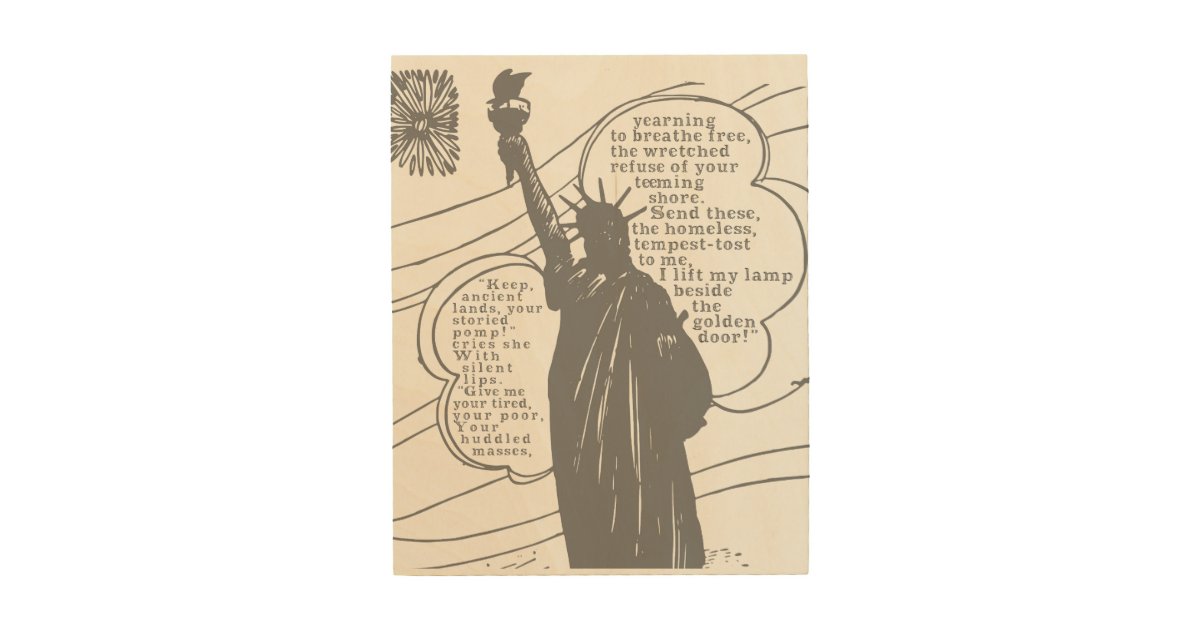
You’ve seen the lines. They’re everywhere. On tote bags, in history books, and definitely in every heated political debate about who gets to call themselves an American. "Give me your tired, your poor, your huddled masses yearning to breathe free." It’s basically the unofficial motto of the United States.
But honestly? The New Colossus poem wasn't even supposed to be there.
When Frédéric Auguste Bartholdi designed the Statue of Liberty, he didn't have immigrants in mind. Not really. He was thinking about "Liberty Enlightening the World"—a grand, somewhat cold French gift celebrating republicanism and the end of slavery after the Civil War. It was supposed to be a lighthouse of Enlightenment ideas, not a welcome mat.
Emma Lazarus changed the vibe entirely.
The Woman Behind the Words
Emma Lazarus wasn't some starving immigrant herself. She was born into a wealthy, high-society Sephardic Jewish family in New York. We’re talking private tutors, multiple languages, and a friendship with Ralph Waldo Emerson. She was the "it" girl of the 19th-century literary scene.
So, why did she write it?
In the 1880s, a wave of brutal anti-Semitic pogroms in Russia sent thousands of Jewish refugees fleeing to New York. Lazarus volunteered with them. She saw the "wretched refuse" (her words, which sound a bit harsh today, but she meant "the people society threw away") firsthand at Ward’s Island.
When she was asked to write a poem to help raise money for the statue’s pedestal, she initially said no. She didn't do "poetry to order." But a friend, Constance Cary Harrison, convinced her to think about what that statue would mean to the people on those cramped, stinking ships.
That changed everything.
The New Colossus Poem: A Deep Meaning
Lazarus didn't just write a poem; she staged a literary coup. She called the statue "Mother of Exiles."
Think about that name for a second.
She was directly contrasting Lady Liberty with the Colossus of Rhodes, that ancient Greek "brazen giant" meant to show off military might. The old Colossus was a man, a conqueror. Lazarus’s "New Colossus" was a woman, a nurturer.
The poem is a Petrarchan sonnet. It’s got that classic structure:
- The Octave (first 8 lines): Sets the scene and describes the statue.
- The Sestet (last 6 lines): The "turn" where the statue actually starts speaking.
"Keep, ancient lands, your storied pomp!" she cries. Basically, she’s telling the old world to keep its kings and its fancy history. America wanted the people the old world didn't want.
What People Get Wrong About the Plaque
Most people think the poem was always a part of the statue. It wasn't.
When the Statue of Liberty was dedicated in 1886, Emma Lazarus wasn't even invited. Nobody read the poem at the ceremony. It didn't appear on a plaque until 1903—sixteen years after Lazarus died of what was likely Hodgkin’s disease.
Her friend, Georgina Schuyler, found the poem in a dusty catalog from the original fundraiser and spent years lobbying to get it recognized. Without Georgina, those famous lines would probably be a footnote in a rare books collection instead of being bronzed in the pedestal.
The Controversy That Never Dies
It’s kinda wild how a 14-line poem can still make people so angry or so inspired.
Some critics argue the poem is "exceptionalist"—that it makes America look like a savior while calling other countries "teeming shores." Others point out the irony that the poem was put up just as the U.S. was passing the Chinese Exclusion Act and tightening its gates.
Then there’s the word "refuse." In the 1880s, it meant the cast-offs or the exiled. Nowadays, it sounds like "trash." It’s a linguistic shift that makes some modern readers cringe, even though Lazarus’s intent was clearly empathetic.
The poem remains a "credo," as the Poetry Foundation puts it. It’s a promise that the U.S. hasn't always kept, but it’s the promise we keep coming back to.
How to Really Experience the History
If you’re actually interested in the legacy of these words, don't just read them on a screen.
- Visit Liberty Island: The original bronze plaque is now in the Statue of Liberty Museum. Seeing it in person, with the salt air hitting your face, hits differently.
- Read the "Octave": Pay attention to the first half of the poem, not just the famous ending. It explains why the statue is "new."
- Research the Pedestal Fund: It’s a fascinating story of "crowdfunding" before the internet existed, led by Joseph Pulitzer.
- Check out the American Jewish Historical Society: They hold the original manuscript.
Basically, the poem is a reminder that the meaning of a monument isn't set in stone (or copper). It’s set by the people who look at it. Emma Lazarus looked at a giant French lighthouse and saw a mother.
And because she did, we all do too.
To get the full weight of the text, read it aloud. Notice the rhythm. It’s not just a slogan; it’s a piece of art that redefined a nation’s identity. If you're heading to NYC soon, make sure to book your pedestal tickets months in advance—they go fast, and that’s where the real history lives.