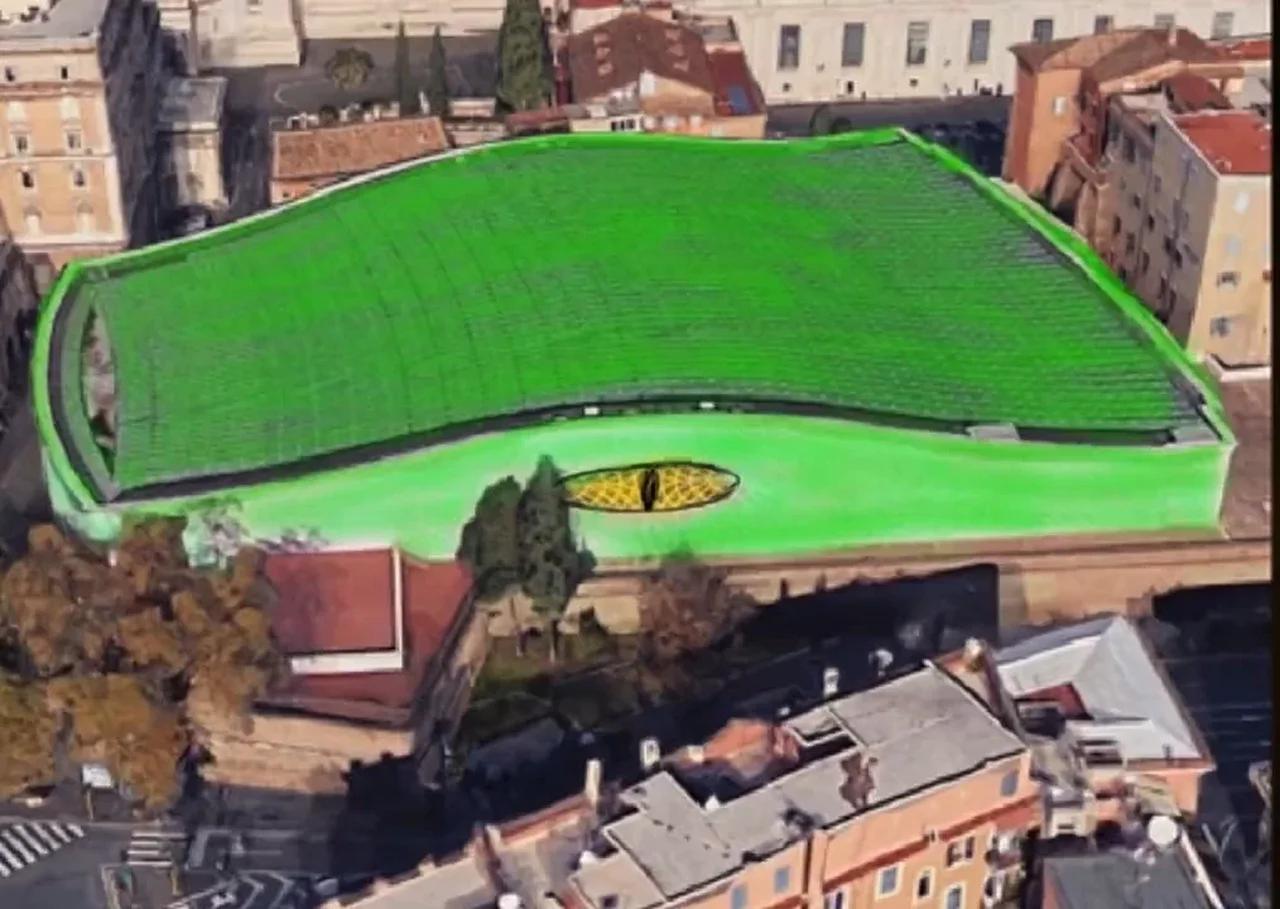
If you’ve spent any amount of time scrolling through the weirder corners of the internet, you’ve probably stumbled across them. I'm talking about Vatican Audience Hall images that look like they belong in a sci-fi thriller rather than a religious landmark. Specifically, that massive, gnarled bronze sculpture that looms behind the Pope. It’s called La Resurrezione (The Resurrection). Honestly, the first time I saw a high-res photo of it, I had to double-check I wasn't looking at a movie set for an alien invasion.
The building itself is officially known as the Paul VI Audience Hall. It was completed in 1971. Architect Pier Luigi Nervi—a guy famous for his love of reinforced concrete—designed it. It’s a massive space. It holds about 6,300 people. But it’s not the capacity that gets people talking; it’s the optics.
The Architecture That Launched a Thousand Memes
When you look at external and internal Vatican Audience Hall images, the "serpent" theory is the first thing that pops up. People point to the curved roof and the two oval windows on the sides. From a specific wide-angle perspective, it kinda looks like the head of a snake. Those windows? They look like slit-pupil eyes. The scales? That’s just the concrete vaulted ceiling.
It’s easy to get sucked into the rabbit hole.
But here’s the thing about Nervi. He was obsessed with structural integrity and acoustics. If you’ve ever been inside a massive marble cathedral, you know the echo is a nightmare for speeches. This hall was built specifically for audiences. That meant the ceiling had to be functional. The undulating curves are actually designed to carry the Pope’s voice to the very back of the room without it turning into a muddy mess of sound. It’s engineering, basically. Not a secret reptilian tribute.
Still, you can't blame people for being weirded out. The lighting is often dim, and the sheer scale of the concrete can feel brutalist and cold. Compared to the gold-leafed majesty of St. Peter’s Basilica right next door, it’s a jarring shift in aesthetic.
The Sculpture Everyone Misinterprets
We need to talk about The Resurrection by Pericle Fazzini. This is the centerpiece of almost every viral photo from the hall. It’s an eighty-ton bronze and copper-alloy behemoth. It depicts Jesus rising from a nuclear crater in the Garden of Gethsemane.
Fazzini started working on this in the late 1960s. Think about the vibe of the world back then. The Cold War was peaking. The threat of nuclear annihilation was a daily reality. Fazzini wasn't trying to make something "pretty." He was trying to show Christ rising out of the absolute worst-case scenario for humanity. He described it as a "tempest of olive trees and earth," but in the context of the atomic age.
When you see close-up Vatican Audience Hall images of the sculpture, Christ’s hair looks like it’s being whipped by a massive explosion. His face is gaunt. It’s haunting. To a casual observer, it can look demonic or skeletal. But if you talk to art historians, they’ll tell you it’s a masterpiece of 20th-century expressionism. It’s supposed to be uncomfortable. Faith, in Fazzini’s view, wasn't just about soft light and cherubs; it was about surviving the fire.
A Few Weird Facts About the Construction:
- The sculpture is actually hollow to keep it from crushing the stage.
- The hall sits partially in Italy and partially in Vatican City territory.
- It took Fazzini nearly seven years to finish the piece, and the stress of the project reportedly contributed to his declining health.
Why the Photos Look So Different Online
Lighting is everything. If you see a photo taken during a bright midday audience, the hall looks like a standard, albeit modern, conference center. The "snake eyes" windows let in plenty of natural light. The concrete looks grey and boring.
But then you see the professional photography or the edited "conspiracy" shots. They crank up the contrast. They deepen the shadows. Suddenly, the bronze sculpture looks like it’s made of writhing bodies. The ceiling looks like skin.
You've also got the "fisheye lens" factor. Because the hall is so wide and relatively low-slung, photographers often use ultra-wide lenses to capture the whole stage. This distorts the edges. It curves the walls. It makes the "serpent head" shape look much more intentional than it actually is when you’re standing there in person. I’ve been there. When you’re walking up the aisle, you’re mostly just thinking about how much your feet hurt and how surprisingly good the air conditioning is.
The Cultural Disconnect
There’s a massive gap between traditional Catholic art and the post-Vatican II modernism found in the Paul VI Hall. Most people expect the Vatican to look like a Renaissance painting. When they see mid-century modern architecture instead, it creates a "uncanny valley" effect. It feels wrong.
The Church was trying to look forward. They wanted to show they were relevant in the modern, scientific, atomic world. They hired Nervi because he was the king of concrete. They hired Fazzini because he was a cutting-edge sculptor.
Ironically, by trying to look "modern," they accidentally created something that looks "occult" to the modern eye. We associate these sharp, jagged, concrete shapes with villain lairs in movies. We don't associate them with the Sermon on the Mount. It’s a classic case of an aesthetic choice aging in a way nobody expected.
How to View These Images Critically
If you’re looking at these photos to understand the Vatican’s actual intent, you have to look past the "gotcha" angles.
- Check the Source: Most of the "serpent" overlays you see on social media are heavily manipulated. They crop out the exits and the seating to force a specific perspective.
- Consider the Era: 1971 was the era of Brutalism. Look at the FBI headquarters in D.C. or the Southbank Centre in London. They all have that same "scary" concrete vibe.
- Look at the Artist’s Intent: Pericle Fazzini was a devout man. His goal wasn't to hide "reptilian" imagery; it was to capture the agony of the garden and the power of the resurrection.
The Hall is used every Wednesday when the Pope is in Rome. It’s a place of prayer and bureaucracy. Thousands of grandmas from all over the world sit in those chairs every week, and most of them aren't thinking about snakes—they’re just trying to get a glimpse of the Pontiff.
Practical Insights for Your Next Visit
If you’re actually planning to go see the hall in person, don’t just rely on the photos you see online. You need a ticket for the Wednesday General Audience. They’re free, but you have to request them through the Prefecture of the Papal Household.
Once you’re inside, walk to the very back and look toward the stage. That’s where the "snake" perspective comes from. Then, walk right up to the front. Look at the texture of the bronze. You’ll see the individual olive branches Fazzini meticulously sculpted. It changes the whole vibe. You realize it’s not a monster; it’s a forest in a storm.
Take your own photos. Use a standard lens, not a wide-angle one. You’ll notice the "creepy" factor drops significantly when the camera isn't distorting the architecture.
The Vatican Audience Hall is a weird building. There is no getting around that. It is a clash of ancient tradition and 1970s experimentalism. But the real story isn't about secret symbols. It’s about a Church trying to figure out how to exist in the age of the nuclear bomb and ending up with a piece of art that still scares people fifty years later.
To get the most out of your research, compare the hall to the Brutalist architecture movement of the 1960s. This provides the necessary historical context to see the building as a product of its time rather than a mystery to be solved. If you want to see the sculpture without the crowds, look for high-resolution archival photos from the Vatican Museums website, which show the detail of the bronze without the distorting effects of amateur cell phone cameras.