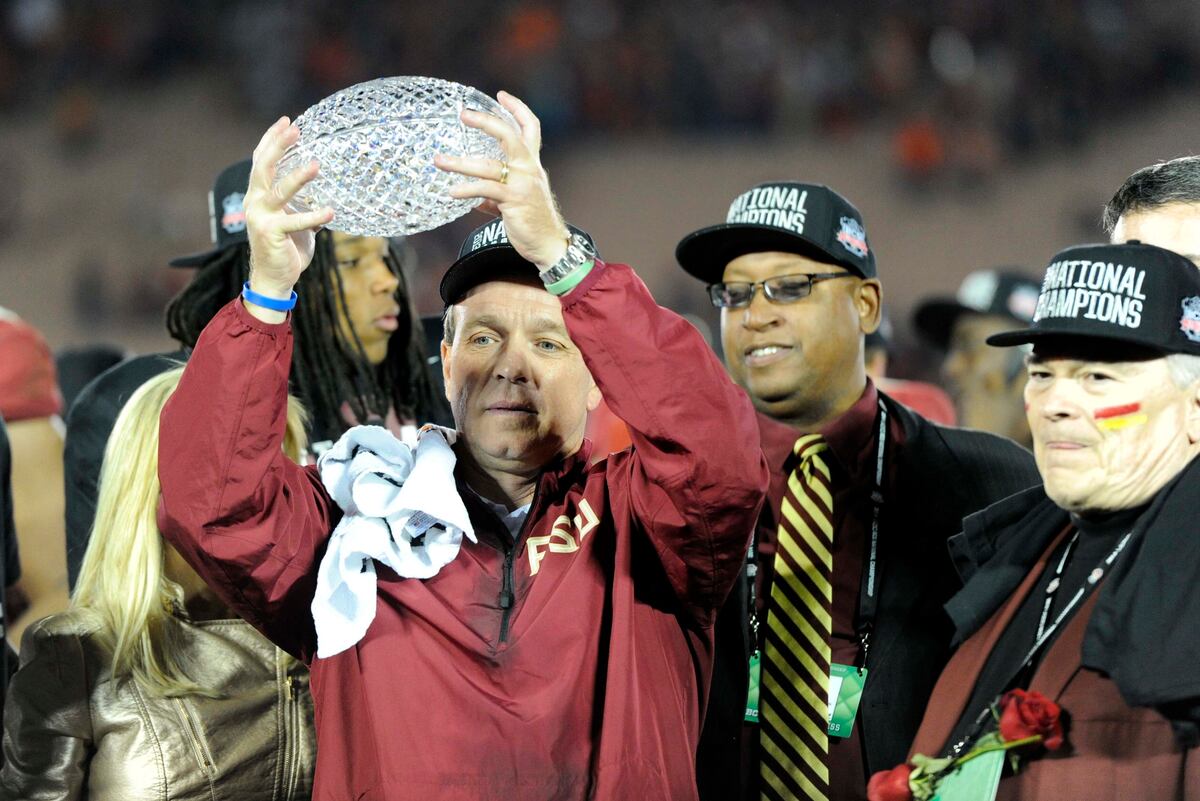
The BCS was a beautiful, chaotic mess. If you grew up watching college football between 1998 and 2013, you know exactly what I mean. It was a system that tried to use math to solve an emotional problem: who is actually number one? Before the College Football Playoff (CFP) arrived with its four-team—and now 12-team—bracket, we had one game. Just one. Two teams, one trophy, and a whole lot of angry fanbases left on the outside looking in.
People talk about the winners of bcs national championship games like they were all consensus champions, but that's rarely the case. Honestly, the system was designed to end the era of "split" championships, where the AP and Coaches polls crowned different teams. It worked... mostly. Except for 2003. We'll get to that mess in a second.
The Early Years: When the SEC Wasn't King (Yet)
In the beginning, the BCS didn't have its own standalone game. The title match just rotated through the "Big Four" bowls: the Fiesta, Sugar, Orange, and Rose.
1998 gave us the first-ever BCS champion in Tennessee. They beat Florida State 23–16 in the Fiesta Bowl. You’ve probably forgotten that the Seminoles were actually playing with a backup quarterback that night because Chris Weinke was out with a neck injury. Tee Martin led the Vols to glory, and for a moment, the world thought the BCS formula was perfect.
Then came the Florida State redemption in 1999. They went "wire-to-wire" as the number one team, beating a Michael Vick-led Virginia Tech in a Sugar Bowl that was much closer than the 46–29 score looks on paper.
Check out the variety of winners from those first few years:
- Oklahoma (2000): A 13–2 slugfest over FSU. Yes, the score was 13 to 2. It was weird.
- Miami (2001): Probably the greatest college team ever assembled. They dismantled Nebraska 37–14.
- Ohio State (2002): The double-overtime thriller against Miami. The "Pass Interference" call that still makes Hurricanes fans see red.
The SEC Takeover and the 2003 Disaster
If you want to know when the SEC started its decade of dominance, look at 2006. But first, we have to talk about the 2003 season. This was the BCS's nightmare scenario.
LSU won the BCS title by beating Oklahoma 21–14. However, USC was ranked #1 in both human polls (AP and Coaches) but got left out of the championship game because the computers hated them. USC went to the Rose Bowl, beat Michigan, and the AP kept them at #1.
Two champions. One trophy. The very thing the BCS was built to stop.
After that, the "standalone" BCS National Championship Game was born in 2006. This is where the SEC decided they weren't going to lose for a while. Starting with Florida in 2006—who absolutely demolished a heavily favored Ohio State 41–14—the SEC won seven straight national titles.
The SEC Win Streak
- LSU (2007): Beat Ohio State 38–24.
- Florida (2008): Tim Tebow at his peak beating Sam Bradford’s Oklahoma.
- Alabama (2009): The start of the Nick Saban dynasty, knocking out Colt McCoy (literally) and Texas.
- Auburn (2010): Cam Newton’s legendary "one-and-done" season.
- Alabama (2011): The "Rematch" where they shut out LSU 21–0.
- Alabama (2012): A 42–14 beatdown of Notre Dame that wasn't even that close.
That One Texas vs. USC Game
You can't talk about winners of bcs national championship games without mentioning the 2006 Rose Bowl (2005 season). Many experts—and basically anyone with a pulse—consider Texas vs. USC the greatest college football game ever played.
USC had two Heisman winners in Matt Leinart and Reggie Bush. They had a 34-game winning streak. They were being called the best team in history before the game even started.
Then Vince Young happened.
His 4th-and-5 scramble into the corner of the end zone with 19 seconds left gave Texas a 41–38 win. It was the peak of the BCS era. It had stars, stakes, and a finish that felt like a movie.
The Forgotten Snubs
While the winners got the crystal football, some teams were arguably "robbed."
In 2004, Auburn went 12–0 in the SEC and didn't even get a chance to play for the title because USC and Oklahoma were also undefeated. In 2011, Oklahoma State was a kick away from potentially keeping Alabama out of the title game.
The computers were cold. They didn't care about "eye tests" or mid-major Cinderella stories. That's why teams like 2008 Utah or 2010 TCU never got their shot at the big game, despite finishing undefeated and winning their respective BCS bowls.
Every Official BCS National Champion (1998–2013)
| Season | Winner | Opponent | Score |
|---|---|---|---|
| 1998 | Tennessee | Florida State | 23–16 |
| 1999 | Florida State | Virginia Tech | 46–29 |
| 2000 | Oklahoma | Florida State | 13–2 |
| 2001 | Miami (FL) | Nebraska | 37–14 |
| 2002 | Ohio State | Miami (FL) | 31–24 (2OT) |
| 2003 | LSU | Oklahoma | 21–14 |
| 2004 | USC (Vacated) | Oklahoma | 55–19 |
| 2005 | Texas | USC | 41–38 |
| 2006 | Florida | Ohio State | 41–14 |
| 2007 | LSU | Ohio State | 38–24 |
| 2008 | Florida | Oklahoma | 24–14 |
| 2009 | Alabama | Texas | 37–21 |
| 2010 | Auburn | Oregon | 22–19 |
| 2011 | Alabama | LSU | 21–0 |
| 2012 | Alabama | Notre Dame | 42–14 |
| 2013 | Florida State | Auburn | 34–31 |
The Final Curtain: Florida State’s Last Stand
The BCS went out with a bang in January 2014. Florida State trailed Auburn by 18 points—the largest comeback in BCS history. Jameis Winston threw a touchdown to Kelvin Benjamin with only 13 seconds left on the clock.
It was a fitting end.
The SEC’s seven-year grip on the trophy was broken by the ACC, and the sport moved into the Playoff era the following year.
The BCS was flawed, sure. It gave us "Computer Rankings" that nobody understood and left out undefeated teams from small conferences. But it also gave us a decade of high-stakes drama where every single Saturday mattered. If you lost one game in October, your season was basically over.
There's a certain nostalgia for that brutality.
Actionable Insights for College Football History Buffs:
- Watch the Replays: If you haven't seen the 2006 Rose Bowl or the 2003 Fiesta Bowl (Ohio State vs. Miami), they are available in full on YouTube. They define the era.
- Understand the "Vacated" Title: You'll notice 2004 USC is often listed with an asterisk. Due to NCAA sanctions involving Reggie Bush, USC was forced to vacate that championship, meaning officially, there was no BCS winner for the 2004 season.
- Compare the Eras: Look at the "Strength of Schedule" metrics used by the BCS versus the current CFP selection committee. It helps you see why certain teams like 2001 Nebraska made it in over 2001 Oregon despite a late-season blowout loss.